Question
For two statements are given-one labelled Assertion (A) and the other labelled Reason (R). Select the correct answer to these questions from the codes (a), (b), (c) and (d) as given below.
  1. Both A and R are true and R is the correct explanation of A.
  2. Both A and R are true but R is not the correct explanation of A.
  3. A is true but R is false.
  4. A is false and R is also false.
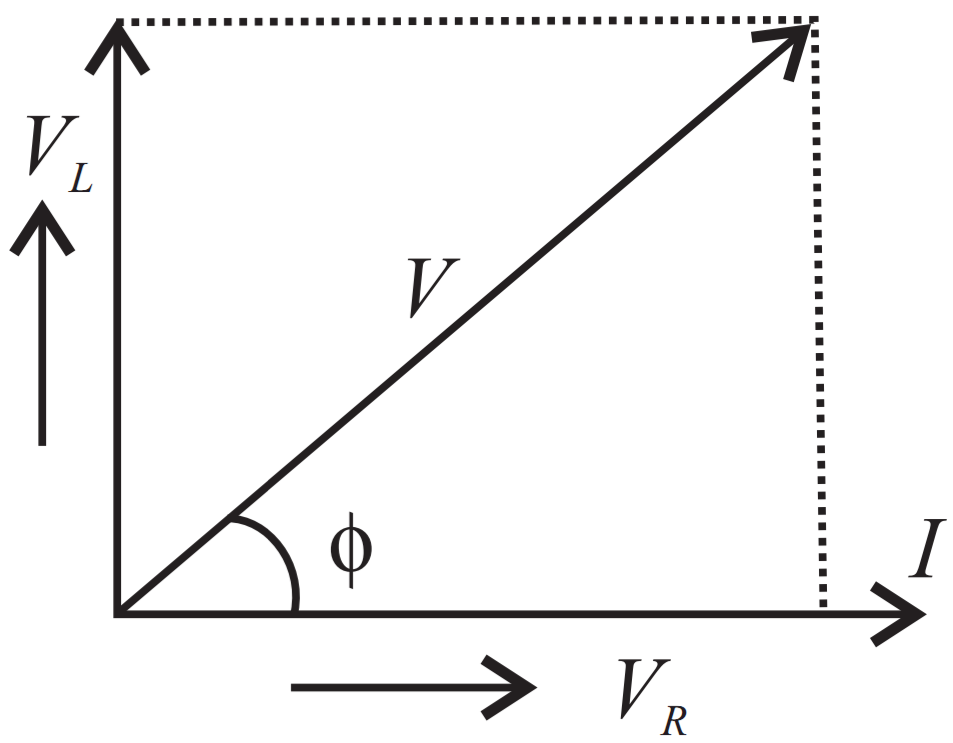
Assertion: An inductance and a resistance are connected in series with an A.C. circuit. ln this circuit the current and the potential difference across the resistance lags behind potential difference across the inductance by an angle $\frac{\pi}{2}.$
Reason: In L-R circuit voltage leads the current by phase angle which depends on the value ofinductance and resistance both.
Answer

  1. Both A and R are true but R is not the correct explanation of A.
Explanation:


As both the inductance and resistance are joined in series, hence current through both will be same. But in case of resistance, both the current and potential vary simultaneously, hence they are in same phase. While in case of an inductance when current is zero, potential difference across it is maximum and when current reaches maximum $\big($at $\omega\text{t}=\frac{\pi}{2}\big),$ potential difference across it becomes zero i.e., potential difference leads the current by $\frac{\pi}{2}$ or current lags behind the potential difference by $\frac{\pi}{2}.$ Phase angle in case of LR circuit is given as $\phi=\tan^{-1}\Big(\frac{\omega\text{L}}{\text{R}}\Big).$

Need a full question paper?

Generate a complete, print-ready paper with questions like this in minutes — across 16+ boards, with answer keys.

Start Generating Free

Similar questions

Two statements are given-one labelled Assertion (A) and the other labelled Reason (R). Select the correct answer to these questions from the codes (a), (b), (c) and (d) as given below.
  1. Both A and R are true and R is the correct explanation of A.
  2. Both A and R are true but R is not the correct explanation of A.
  3. A is true but R is false.
  4. A is false and R is also false.
Assertion: Endoscopy involves use of optical fibres to study intemal organs.
Reason: Optical fibres are based on phenomena of total internal reflection.
For question two statements are given-one labelled Assertion (A) and the other labelled Reason (R). Select the correct answer to these questions from the codes (a), (b), (c) and (d) as given below.
  1. Both A and R are true, and R is the correct explanation of A.
  2. Both A and R are true, but R is NOT the correct explanation of A.
  3. A is true, but R is false.
  4. A is false and R is also false.
Assertion (A): Between any two given energy levels, the number of absorption transitions is always less than the number of emission transitions.
Reason (R): Absorption transitions start from the lowest energy level only and may end at any higher energy level. But emission transitions may start from any higher energy level and end at any energy level below it.
Two statements are given-one labelled Assertion(A) and the other labelled Reason (R). Select the correct answer to these questions from the codes(a), (b), (c) and (d) as given below.
  1. Both A and R are true and R is the correct explanation of A.
  2. Both A and R are true but R is NOT the correct explanation of A.
  3. A is true but R is false.
  4. A is false and R is also false.
Assertion (A): A clinic lines on the magnetic map represents lines of equal dip.
Reason (R): When the horizontal and vertical components of the earth's magnetic field are equal, the angle of dip is 60º.
For question, statements are given-one labelled Assertion $(A)$ and the other labelled Reason $(R)$. Select the correct answer to these questions from the codes $(a) (b) (c)$ and $(d)$ as given below.
Assertion $(A):$ Nuclear density is extremely higher than atomic density.
Reason $(R):$ Most of the mass of the atom is concentrated in the nucleus.
For question two statements are given-one labelled Assertion (A) and the other labelled Reason (R). Select the correct answer to these questions from the codes (a), (b), (c) and (d) as given below.
  1. Both A and R are true, and R is the correct explanation of A.
  2. Both A and R are true, but R is NOT the correct explanation of A.
  3. A is true, but R is false.
  4. A is false and R is also false.
Assertion (A): Laser is used to measure distant object like moon.
Reason (R): They are highly coherent source of light.
For two statements are given-one labelled Assertion (A) and the other labelled Reason (R). Select the correct answer to these questions from the codes (a), (b), (c) and (d) as given below.
  1. Both A and R are true, and R is the correct explanation of A.
  2. Both A and R are true, but R is not the correct explanation of A.
  3. A is true but R is false.
  4. A is false and R is also false.
Assertion (A): Charging is due to transfer of electrons.
Reason (R): Mass of a body decreases slightly when it is negatively charged.
Assertion (A): An electric lamp is connected in series with a long solenoid of copper with air core and then connected to ac source. If an iron rod is inserted in solenoid, the lamp will become dim.
Reason (R): If an iron rod is inserted in solenoid, the inductance of solenoid increases.
For question, statements are given-one labelled Assertion $(A)$ and the other labelled Reason $(R).$ Select the correct answer to these questions from the codes $(a) (b) (c)$ and $(d)$ as given below.
Assertion $(A):$ Two protons can attract each other.
Reason $(R):$ The distance between the protons within the nucleus is about $10^{-15}m$
For two statements are given-one labelled Assertion (A) and the other labelled Reason (R). Select the correct answer to these questions from the codes (a), (b), (c) and (d) as given below.
  1. Both A and R are true, and R is the correct explanation of A.
  2. Both A and R are true, but R is not the correct explanation of A.
  3. A is true, but R is false.
  4. A is false, and R is also false.
Assertion (A): When air between the plates of a parallel plate condenser is replaced by an insulating medium of dielectric constant its capacity increases.
Reason (R): Electric field intensity between the plates with dielectric in between it is reduced.
For two statements are given-one labelled Assertion (A) and the other labelled Reason (R). Select the correct answer to these questions from the codes (a), (b), (c) and (d) as given below.
Assertion (A): The electric flux emanating out and entering a closed surface are $8 \times 10^3$ and $2 \times 10^3 \mathrm{Vm}$ respectively. The charge enclosed by the surface is $0.053\mu\text{C}.$
Reason (R): Gauss's theorem in electrostatics may be applied to verify.