MCQ
For two statements are given$-$one labelled Assertion and the other labelled Reason. Select the correct answer to these questions from the codes $(a), (b), (c)$ and $(d)$ as given below.
Assertion: All sexually transmitted diseases are completely curable if it is detected and treated properly in primary stage.
Reason: $\text{HIV}$ infection is completely curable with drugs like Zidovudine, Didanosine and Azidothymidine.
  • A
    Both assertion and reason are true, and reason is the correct explanation of assertion.
  • B
    Both assertion and reason are true, but reason is not the correct explanation of assertion.
  • C
    Assertion is true, but reason is false.
  • Both assertion and reason are false.

Answer

Correct option: D.
Both assertion and reason are false.
$\text{HIV}$ infection, hepatitis$-B$ and genital herpes are incurable $\text{STDs. HIV}$ infection causes $\text{AIDS}.$ Although there is no cure of $\text{AIDS},$ yet use of certain drugs like Zidovudine, Azidothymidine and Didanosine can prolong the life of $\text{AIDS}$ patient.

Need a full question paper?

Generate a complete, print-ready paper with questions like this in minutes — across 16+ boards, with answer keys.

Start Generating Free

Similar questions

Directions : In the following questions, the Assertions $(A)$ and Reason $(s) \ (R)$ have been put forward. Read both the statements carefully and choose the correct alternative from the following:
Assertion : $\text{PCR}$ can detect very low amounts of $\text{DNA}$ and is now routinely used to defect $\text{HIV}$ in suspected $\text{AIDS}$ patient.
Reason : $\text{PCR}$ is a powerful technique to identify many other genetic disorders.
For question, two statements are given$-$one labelled Assertion and the other labelled Reason. Select the correct answer to these questions from the codes $(a), (b), (c)$ and $(d)$ as given below.
Assertion: The subunits of ribosomes come together only at the time of protein formation.
Reason: $Mg^{2+}$ causes their association or dissociation.
For question, two statements are given$-$one labelled Assertion and the other labelled Reason. Select the correct answer to these questions from the codes $(a), (b), (c)$ and $(d)$ as given below.
Assertion : Smack is a by$-$product of heroin synthesis.
Reason: Heroin is an opium alkaloid.
Read the following and answer any four questions from $(i)$ to $(v)$ given below:
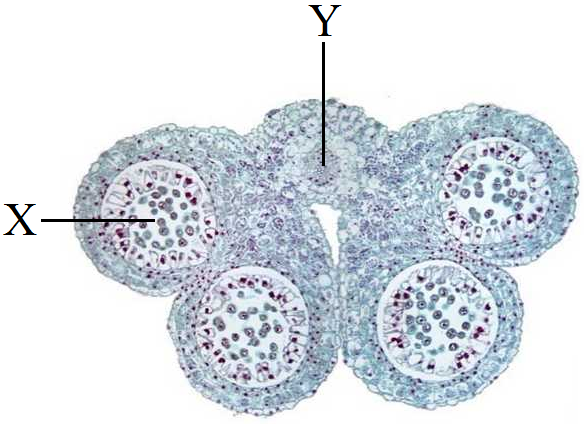
Many adaptations are found in flowers to achieve certain kind of pollination. The pollination achieved by insects is known as entomophily. The given diagram shows the cross-section of an anther of an insect pollinated flower.
  1. Which of the following is/ are the function $(s)$ of structure $Y$?
  1. To carry waste products away from the anther.
  2. To supply oxygen to the cells of the anther.
  3. To transport food and mineral salts to the anther.
  4. To supply water to the anther.
  1. Conly.
  2. $C$ and $D$ only.
  3. $A, B$ and $D$ only.
  4. $A, B, C$ and $D$.
  1. Which of the following most accurately describes the structures found in compartment $X$?
  1. They contain two haploid nuclei resulting from meiosis.
  2. They contain two haploid nuclei resulting from mitosis.
  3. They contain two haploid male gametes, resulting from mitosis.
  4. They contain a vegetative nucleus and pollen tube nucleus.
  1. Which of the following is a distinctive characteristic of insect $-$ pollinated flower?
  1. All of them have nectar guides on their flowers.
  2. They produce sugary fruit.
  3. Their pollen grains tend to have rough surfaces.
  4. They produce abundant quantities of pollen to make up for pollen grains that might be removed by the wind.
  1. Which of the following are likely characteristics of the structures found in $X$ and stamens of this plant?
S. No
Structure of $X$
Stamens
$(a)$
Abundant and light
Pendulous
$(b)$
Rough surfaces
Non $-$ pendulous
$(c)$
Light and sticky
Pendulous
$(d)$
Coarse and sticky
Protrude outside the flower
  1. Spiny or sticky pollen grains and large, attractively coloured flowers are associated with :
  1. Hydrophily.
  2. Entomophily.
  3. Ornithophily.
  4. Anemophily.
For question two statements are given$-$one labelled Assertion and the other labelled Reason. Select the correct answer to these questions from the codes $(a), (b), (c)$ and $(d)$ as given below.
Assertion : Test cross is a back cross.
Reason: In test cross, individual is crossed with recessive paren.
For two statements are given$-$one labelled Assertion and the other labelled Reason. Select the correct answer to these questions from the codes $(a), (b), (c)$ and $(d)$ as given below.
Assertion: Pollen grains of many insect pollinated species are sticky.
Reason: In the anemophilous flower, the pollen grains are powdery and non$-$sticky.
For question two statements are given $-$ one labelled Assertion and the other labelled Reason. Select the correct answer to these questions from the codes $(a), (b), (c)$ and $(d)$ as given below.
Assertion : Many plants growing in oli gotroph ic soi Is possess mycorrhizae.
Reason : Mycorrhizae help in efficient absorption of nutrients.
Two statements are given$-$one labelled Assertion and the other labelled Reason. Select the correct answer to these questions from the codes $(a), (b), (c)$ and $(d)$ as given below.
Assertion: Bacteriophage vectors are more advantageous than plasmid vectors.
Reason: Bacteriophage vectors can be easily detected at the time of cloning experiments.
For question two statements are given$-$one labelled Assertion and the other labelled Reason. Select the correct answer to these questions from the codes $(a), (b), (c)$ and $(d)$ as given below.
Assertion: Hybrids are generally back crossed.
Reason: Back cross is done to increase the traits of the parent.
Read the following and answer any four questions from $(i)$ to $(v)$ given below:
Pollen$-p$istil interaction is the group of events that occur from the time of pollen deposition over the stigma to the time of pollen tube entry into ovule. It is a dynamic process which has checks at several places for promotion or inhibition of pollen growth. Pollen$-$pistil interaction is a safety measure to ensure that illegitimate crossings do not occur. Compatibility and incompatibility of the pollen$-$pistil is determined by special proteins. The compatible pollens are able to absorb water and nutrients from the surface of the stigma. They germinate and produce pollen tubes. Pollen tubes grow into the style. Their growth and path through the style are also determined by specific chemicals.
  1. Which of the following parts of gynoecium determines the compatible nature of pollen?
  1. Stigma.
  2. Style.
  3. Ovary.
  4. Thalamus.
  1. In Triforium, which type of self$-$incompatibility is found?
  1. Gametophytic self$-$incompatibility $(\text{GSI}).$
  2. Sporophytic self$-$incompatibility $(\text{SSI}).$
  3. Both $\text{GSI}$ and $\text{SSI}.$
  4. None of these.
  1. Select the incorrect statement.
  1. In Asteraceae, incompatibility is due to the genotype of the sporophytic stigmatic tissues.
  2. In members of Brassicaceae, incompatibility is due to the genotype of the pollen.
  3. Nature has imposed self$-$incompatibility to avoid highly homozygous individuals, which have a very low survival value.
  4. None of these.
  1. Which of the following are examples of self incompatibility?
  1. Tobacco.
  2. Potato.
  3. Crucifers.
  4. All of these.
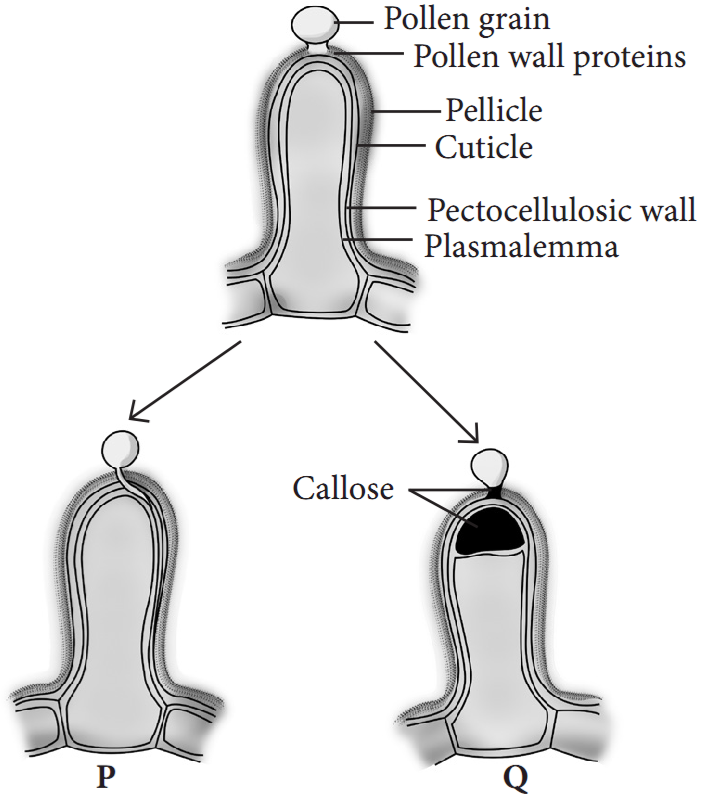
  1. Given figures show the pollen$-$stigma interaction, where pollen wall proteins are released onto the pellicle of stigmatic papillae, where a recognition reaction occurs.


Which of the following statements drawn from given figures is incorrect?
  1. $P$ indicates compatible reaction in which the pollen tube penetrates the cuticle and grows down the papilla.
  2. Development of callose plug between the plasma membrane and pectocellulosic layer of stigmatic papillae results in the incompatibility reaction in $Q$.
  3. A callose plug, which appears at the tip of pollen in $Q$, is dissolved by callase enzyme secreted by stigma resulting in compatibility reaction.
  4. Deposition of callose can be employed as a reliable bioassay to detect compatibility or incompatibility reactions of pollen and stigma.