Question
For which colour the magnifying power of a simple microscope is highest? For which colour it is lowest?

Answer

It is highest for violet and lowest for red colour since M $=1+\frac{\text{D}}{\text{f}}\text{ and }\text{fv}<\text{f}_{\text{R}}.$

Need a full question paper?

Generate a complete, print-ready paper with questions like this in minutes — across 16+ boards, with answer keys.

Start Generating Free

Similar questions

Is it necessary to express all angles in radian while using the equation $\omega=\omega_0+\text{at}?$
A wheel with 10 metallic spokes each $0.5 m$ long is rotated with a speed of $120 rev / min$ in a plane normal to the horizontal component of earth's magnetic field $H_E$ at a place. If $H_E=0.4 G$ at the place, what is the induced emf between the axle and the rim of the wheel? Note that $1 G =10^{-4} T$.
A cylindrical object of outer diameter 20cm and mass 2kg floats in water with its axis vertical. If it is slightly depressed and then released, find the time period of the resulting simple harmonic motion of the object.
Which part of electromagnetic spectrum is used in satellite communication?
Answer the following questions:
Is Ohm’s law universally applicable for all conducting elements? If not, give examples of elements which do not obey Ohm’s law.
What is the importance of Kirchhoff's laws related to electric circuit?
Answer the following questions, which help you understand the difference between Thomson’s model and Rutherford’s model better.

Keeping other factors fixed, it is found experimentally that for small thickness t, the number of α-particles scattered at moderate angles is proportional to t. What clue does this linear dependence on t provide?
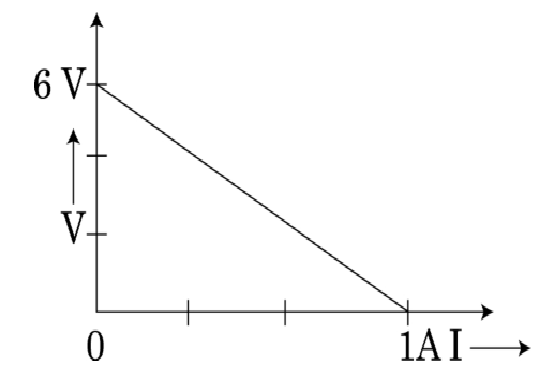
The plot of the variation of potential different across a combination of three identical cells in series, versus current is shown below. What is the emf and internal resistance of each cell?

The capacitance of a charged capacitor is C and the energy stored in it is U. What is the value of charge on the capacitor?
A person is viewing an extended object. If a converging lens is placed in front of his eyes, will he feel that the size has increased?