MCQ
For which of the following processes, $\Delta S$  is negative?
  • A
    $C$ (diamond) $\to$  $C$ (graphite)
  • B
    $N_2(g,\,1\,atm) \to  N_2(g,\,5\,atm)$
  • C
    $N_2(g,\,273\,K) \to  N_2(g,\,300\,K)$
  • D
    $H_2(g) \to  2H(g)$

Answer

$(a)$ When diamond is converted into graphite when it is heated to $1500\,^oC$ and entropy is increased so $\Delta S > 0$
$(b)$ When pressure increases then molecules of gas will come closer and intermolecular distance decreases so entropy will also decrease and $\Delta S < 0$
$(c)$ When we increase the temperature of a gas then random ness is increased due to kinetic energy gained by molecules. So, $\Delta S > 0$
$(d)$  $H_2$ molecule is converted into atoms, the no. of particles increases . Thus entropy will increase. So, $\Delta S > 0$

Need a full question paper?

Generate a complete, print-ready paper with questions like this in minutes — across 16+ boards, with answer keys.
Start Generating Free

Similar questions

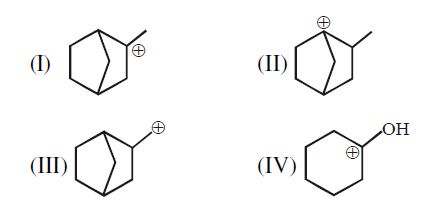
Find out correct stability order in the following carbocations-
The rate of nitration will be
Acetaldehyde can be converted into $\begin{array}{*{20}{c}}
  {\,\,\,\,\,\,\,\,\,\,\,\,\,\,\,\,\,\,\,\,\,\,\,\,\,\,\,C{H_2}OH} \\ 
  {\,\,\,\,\,\,\,\,\,\,\,|} \\ 
  {HO\, - \,C{H_2} - C - C{H_2}OH} \\ 
  {\,\,\,\,\,\,\,\,\,\,\,|} \\ 
  {\,\,\,\,\,\,\,\,\,\,\,\,\,\,\,\,\,\,\,\,\,\,\,\,\,\,\,\,\,\,C{H_2}OH} 
\end{array}$ by which reagent ?
The elements with atomic number $10, 18, 36, 54$ and $86$ are all
Which one of the following pairs of isomers and types of isomerism are correctly  matched? 

$(i)\, [Co(NH_3)_5(NO_2 )]Cl_2$ and $[Co(NH_3)_5(ONO) ]Cl_2$ .... (Linkage)

$(ii)\, [Cu (NH_3)_4 ] [PtCl_4]$ and $[Pt(NH_3)_4] [CuCl_4]$ .... (Coordination)

$(iii)\, [PtCl_2 (NH_3)_4] Br_2$ and $[PtBr_2(NH_3)_4]Cl_2$  .... (Ionization)

Select the correct answer using the codes given below

Which of the following set of quantum numbers belong to highest energy
Which of the following oxides is the most acidic
The ammonia prepared by treating ammonium sulphate with calcium hydroxide is completely used by $\mathrm{NiCl}_2 .6 \mathrm{H}_2 \mathrm{O}$ to form a stable coordination compound. Assume that both the reactions are $100 \%$ complete. If $1584 \mathrm{~g}$ of ammonium sulphate and $952 \mathrm{~g}$ of $\mathrm{NiCl}_2 \cdot 6 \mathrm{H}_2 \mathrm{O}$ are used in the preparation, the combined weight (in grams) of gypsum and the nickelammonia coordination compound thus produced is $\qquad$ (Atomic weights in $\mathrm{g} \mathrm{mol}^{-1}: \mathrm{H}=1, \mathrm{~N}=14, \mathrm{O}=16, \mathrm{~S}=32, \overline{\mathrm{Cl}=35.5}, \mathrm{Ca}=40, \mathrm{Ni}=59$ )
$SbF_5$ reacts with $XeF_4$ and $XeF_6$ to form ionic compounds $[XeF^+_3 ][SbF^-_6 ]$ and $[XeF^+_5][SbF^-_6 ]$ then molecular shape of $[XeF^+_3]$  ion and $[XeF^+_5]$ ion respectively
The electronic configuration with the highest ionization enthalpy is