MCQ
For which order reaction a straight line is obtained along with $x\,-$ axis by plotting a graph between half life $({t_{1/2}})$ and initial concentration $ 'a'$
  • A
    $2$
  • $1$
  • C
    $3$
  • D
    $0$

Answer

Correct option: B.
$1$
b
We know that $t_{\frac{1}{2}} \propto a^{1-n}$

The graph to be straight line $t_{\frac{1}{2}}$ should be independent of $a$ That is $1-n=0,$ hence $n=1$

It is a first order reaction.

Need a full question paper?

Generate a complete, print-ready paper with questions like this in minutes — across 16+ boards, with answer keys.

Start Generating Free

Similar questions

Which of the following statement is correct with respect to the property of elements in the carbon family with an increase in atomic number, their
For the reaction $A + B \to $ products, what will be the order of reaction with respect to $A$ and $B$ ?
   Exp.    $[A]\,(mol\,L^{-1})$   $[B]\,(mol\,L^{-1})$   Initial rate    $(mol\,L^{-1}\,s^{-1})$ 
   $1.$  $2.5\times 10^{-4}$  $3\times 10^{-5}$  $5\times 10^{-4}$
   $2.$   $5\times 10^{-4}$  $6\times 10^{-5}$  $4\times 10^{-3}$
   $3.$   $1\times 10^{-3}$  $6\times 10^{-5}$  $1.6\times 10^{-2}$
$Ph - C \equiv N\xrightarrow[{\left( {Partial\,hydrolysis} \right)}]{{{H_3}\mathop O\limits^ \oplus  }}\left( A \right)\xrightarrow{{B{r_2} + KOH}}\left( B \right)$

Product $(B)$ is

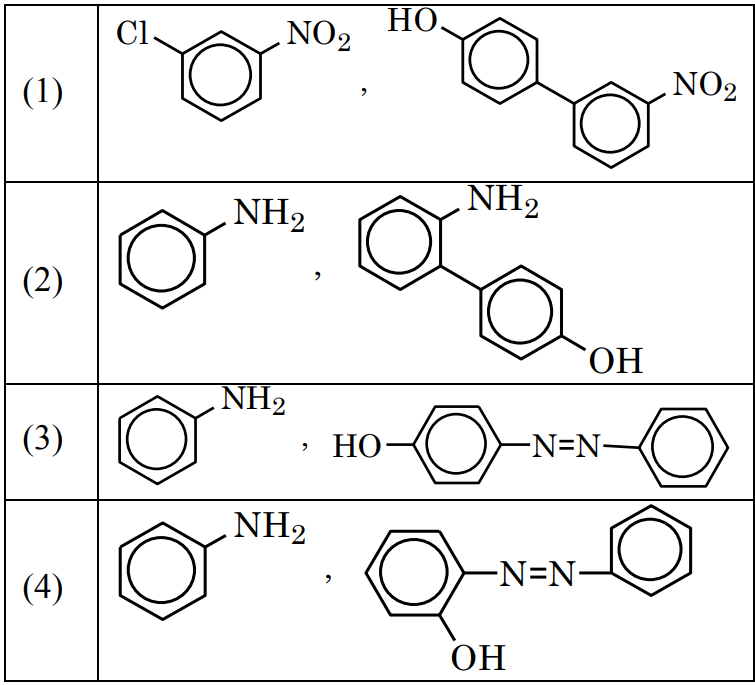
The products A and B formed in the following reaction scheme are respectively
(i) conc. $HNO _3 /$ conc. $H _2 SO _4$
Image

Image
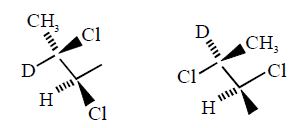
How are the following compounds related
The starting substance for the preparation of $C{H_3}I$ is
A solution containing $N{a_2}C{O_3}$ and $NaOH$ requires $300\, ml$ of $0.1\, N$ $HCl$ using phenolpthalein as an indicator. Methyl orange is then added to the above titrated solution when a further $25\, ml$ of $0.2\, N$ $HCl$ is required. The amount of $NaOH$ present in solution is  ................. $\mathrm{g}$  $(NaOH = 40,\,N{a_2}C{O_3} = 106)$
Compound $(C)$ is
What amount of bromine will be required to convert 2 g of phenol into 2, 4, 6-tribromophenol ? (Given molar mass in $g mol ^{-1}$ of $C , H , O , Br$ are $12,1,16,80$ respectively)
Consider the reaction

${N_2}(g)\, + 3{H_2}(g)\, \rightleftharpoons \,2N{H_3}(g)$ 

The equilibrium constant of the above reaction is $K_3$. If pure ammonia is left to dissociate, the partial pressure of ammonia at equilibrium is given by (Assume that $P_{NH_3}<\,< P_{total}$ at equilibrium)