MCQ
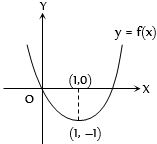
For which value of  $x$ , the function $f(x) = {x^2} - 2x$ is decreasing
  • A
    $x > 1$
  • B
    $x > 2$
  • $x < 1$
  • D
    $x < 2$

Answer

Correct option: C.
$x < 1$
c
(c) $f(x) = {(x - 1)^2} - 1$. Hence decreasing in $ x < 1.$

Aliter : $f'(x) = 2x - 2 = 2(x - 1)$

To be decreasing, $2(x - 1) < 0 \Rightarrow (x - 1) < 0 \Rightarrow x < 1$.
Need a full question paper?

Generate a complete, print-ready paper with questions like this in minutes — across 16+ boards, with answer keys.

Start Generating Free

Similar questions

Let f : R → R be a function defined by f(x) = x3 + 4, then f is:
  1. Injective.
  2. Surjective.
  3. Bijective.
  4. None of these.
If $\int\text{x}\sin\text{x dx}=-\text{x}\cos\text{x}+\text{a},$ then a is equal to:
  1. $\sin\text{x}+\text{C}$
  2. $\cos\text{x}+\text{C}$
  3. $\text{C}$
  4. none of these.
The solution of $y{e^{ - x/y}}dx - (x{e^{ - x/y}} + {y^3})dy = 0$ is
Area under the curve $y = \sqrt {3x + 4} $ between $x = 0$ and $x = 4,$ is
Out of the following points, how many points are satisfied the inequality $2 x-3 y>-5 ?$

$(1,1)(-1,1),(1,-1),(-1,-1),(-2,1)(2,-1),(-1,2)$ and $(-2,-1)$

A line $L$ : $y=m x+3$ meets $y$ - axis at $E(0,3)$ and the arc of the parabola $y^2=16 x, 0 \leq y \leq 6$ at the point $F\left(x_0, y_0\right)$. The tangent to the parabola at $F\left(x_0, y_0\right)$ intersects the $y$-axis at $G\left(0, y_1\right)$. The slope $m$ of the line $L$ is chosen such that the area of the triangle EFG has a local maximum

Match List $I$ with List $II$ and select the correct answer using the code given below the lists :

List $I$ List $II$
$P.$ $\quad$m= $1.$ $\quad\frac{1}{2}$
$Q.$ $\quad$Maximum area of $\triangle E F G$ is $2.$ $\quad4$
$R.$ $\quad y_0=$ $3.$ $\quad2$
$S.$ $\quad y_1=$ $4.$ $\quad1$

Codes: $ \quad P \quad Q \quad R \quad S $ 

Choose the correct answer in Exercises:
$\int\frac{10\text{x}^9+10^{\text{x}}\log_\text{e}10}{\text{x}^{10}+10^{\text{x}}}\text{ equals}$
  1. $10^\text{x}-\text{x}^{10}+\text{C}$
  2. $10^\text{x}+\text{x}^{10}+\text{C}$
  3. $(10^\text{x}-\text{x}^{10})^{-1}+\text{C}$
  4. $\log(10^\text{x}+\text{x}^{10})+\text{C}$
Considering only the principal values of the inverse trigonometric functions, the value of

$\frac{3}{2} \cos ^{-1} \sqrt{\frac{2}{2+\pi^2}}+\frac{1}{4} \sin ^{-1} \frac{2 \sqrt{2} \pi}{2+\pi^2}+\tan ^{-1} \frac{\sqrt{2}}{\pi}$ is. . . . 

Evaluate: $\int \frac{d x}{5-8 x-x^2}$
The solution of $(x - {y^3})dx + 3x{y^2}dy = 0$ is