MCQ
Force between the protons and neutrons in a nucleus is:
- AOnly coulombian
- BOnly nuclear
- CBoth (a) and (b)
- DNone of these
Explanation:
CONCEPT:
Strong nuclear force: The strong attractive force which binds together the protons and neutrons in a nucleus is called a strong nuclear force.
Important properties of the strong nuclear force:
From the above, it is clear that the force between a neutron and a proton inside the nucleus is only nuclear attractive.
Generate a complete, print-ready paper with questions like this in minutes — across 16+ boards, with answer keys.
Four wires each of length 2.0 metres are bent into four loops P, Q, R and S and then suspended into uniform magnetic field. Same current is passed in each loop. Which statement is correct
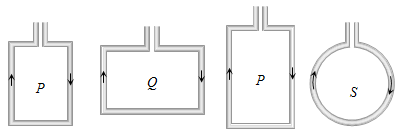
|
(a) Couple on loop P will be the highest |
(b) Couple on loop Q will be the highest |
|
(c) Couple on loop R will be the highest |
(d) Couple on loop S will be the highest |
The average life T and the decay constant λ of a radioactive nucleus are related as
|
(a) T λ = 1 |
(b) T = |
(c) |
(d) T = |
The half life period of a radioactive element X is same as the mean life time of another radioactive element Y. Initially both of them have the same number of atoms. Then
|
(a) X and Y have the same decay rate initially |
|
(b) X and Y decay at the same rate always |
|
(c) Y will decay at a faster rate than X |
|
(d) X will decay at a faster rate than Y |
Two bulbs, one of 50 watt and another of 25 watt are connected in series to the mains. The ratio of the currents through them is
|
(a) 2 : 1 |
(b) 1 : 2 |
|
(c) 1 : 1 |
(d) Without voltage, cannot be calculated |
A freshly prepared radioactive sample of half- life 1 hour emits radiations that are 128 times as intense as the permissible safe limit. The minimum time after which this sample can be safely used is
|
(a) 14 hours |
(b) 7 hours |
(c) 128 hours |
(d) 256 hours |
When yellow light is incident on a surface, no electrons are emitted while green light can emit. If red light is incident on the surface, then
|
(a) No electrons are emitted |
|
(b) Photons are emitted |
|
(c) Electrons of higher energy are emitted |
|
(d) Electrons of lower energy are emitted |


