MCQ
Force between the two parallel wires carrying currents has been used to define:
- AAmpere
- BCoulomb
- CVolt
- DWatt
Explanation:
Ampere is defined as the constant current that will produce an attractive force of 2×10⁻⁷ newton per metre of length between two straight, parallel conductors (carrying the constant current) of infinite length and negligible circular cross section placed one metre apart in a vacuum. This is the Ampere's Force Law.
Generate a complete, print-ready paper with questions like this in minutes — across 16+ boards, with answer keys.
An electron and a proton are at a distance of 1 . The moment of this dipole will be (C X m)
|
(a) 1.6 |
(b) 1.6 |
(c) 3.2 |
(d) 3.2 |
For intensity I of a light of wavelength 5000Å the photoelectron saturation current is 0.40 μA and stopping potential is 1.36 V, the work function of metal is
|
(a) 2.47 eV |
(b) 1.36 eV |
(c) 1.10 eV |
(d) 0.43 eV |
Two capacitors C1 and C2 = 2C1 are connected in a circuit with a switch between them as shown in the figure. Initially the switch is open and C1 holds charge Q. The switch is closed. At steady state, the charge on each capacitor will be
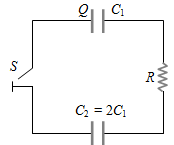
|
(a) Q, 2Q |
(b) Q/3, 2Q/3 |
(c) 3Q/2, 3Q |
(d) 2Q/3, 4Q/3 |
In a meter bridge, the balancing length from the left end (standard resistance of one ohm is in the right gap) is found to be 20 cm. The value of the unknown resistance is
|
(a) 0.8 Ω |
(b) 0.5 Ω |
(c) 0.4 Ω |
(d) 0.25 Ω |
An electron and a proton are in a uniform electric field, the ratio of their accelerations will be
|
(a) Zero |
|
(b) Unity |
|
(c) The ratio of the masses of proton and electron |
|
(d) The ratio of the masses of electron and proton |
The focal lengths of the objective and eye-lens of a microscope are 1 cm and 5 cm respectively. If the magnifying power for the relaxed eye is 45, then the length of the tube is
|
(a) 30 cm |
(b) 25 cm |
(c) 15 cm |
(d) 12 cm |
The idea of secondary wavelets for the propagation of a wave was first given by
|
(a) Newton |
(b) Huygen |
(c) Maxwell |
(d) Fresnel |
A potentiometer is an ideal device of measuring potential difference because
|
(a) It uses a sensitive galvanometer |
|
(b) It does not disturb the potential difference it measures |
|
(c) It is an elaborate arrangement |
|
(d) It has a long wire hence heat developed is quickly radiated |


