MCQ
Force between two charges at rest is $........$?
  • electrostatic force.
  • B
    elector magnetic force.
  • C
    real force.
  • D
    dynamic force.

Answer

Correct option: A.
electrostatic force.

Force between two charges at rest is electrostatic force of coulomb's law.

Need a full question paper?

Generate a complete, print-ready paper with questions like this in minutes — across 16+ boards, with answer keys.
Start Generating Free

Similar questions

A convex lens is put $10\, cm$ from a light source and it makes a sharp image on a screen, kept $10\, cm$ from the lens. Now a glass block (refractive index $1.5$) of $1.5\, cm$ thickness is placed in contact with the light source. To get the sharp image again, the screen is shifted by a distance $d$. Then $d$ is
A transmitter transmits a power of $10\, kW$ when modulation is $50\%$. Power of carrier wave is.......$kW$
In a Young’s double slit experiment, ${I_o}$ is the intensity at the central maximum and $\beta $ is the fringe width. The intensity at a point $P$ distant $x$ from the centre will be
In terms of Rydberg's constant R, the wave number of the first Balmer line is
A conducting sphere of radius $r$ has a charge. Then
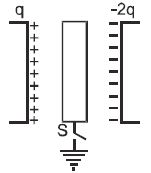
The metal plate on the left in figure carries a charge $+q$. The metal plate on the right has a charge of $-2q$. What charge will flow through $S$ when it is closed, if central plate is initially neutral
A diode detector is used to detect and amplitude modulated wave of $60 \%$ modulation by using a condenser of capacity $250\, pF$ in parallel with a load resistance $100\, k \Omega$. Find the maximum modulated frequency which could be detected by it,
Match the List $I$ with the List $II$ from the combination shown. In the left side (List $I$) there are four different conditions and in the right side (List $II$), there are ratios of heat produced in each resistance for each condition :
List $I$ List $II$ 
$(I)$ Two wires of same resistance are connected in series and same current is passed through them $(A)$ $1:2$
$(II)$ Two wires of resistance $R$ and $2R$ $ohm$ are connected in series and same $P . D .$ is applied across them $(B)$ $4:1$
$(III)$ Two wires of same resistance are connected in parallel and same current is flowing through them $(C)$ $1:1$
$(IV)$ Two wires of resistances in the ratio $1:  2$ are connected in parallel and same $P . D .$ is applied across the $(D)$ $2:1$
Huygen’s principle of secondary wavelets may be used to
The net resistance of a voltmeter should be large to ensure that