Question
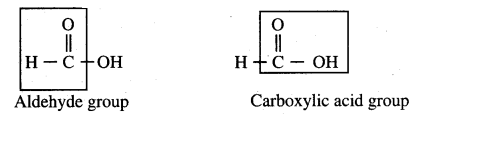
Formic acid act as reducing agent. Prove this statement.

Answer

1. Formic acid contains both an aldehyde as well as an acid group. Hence, like other aldehydes, formic acid can easily be oxidised and therefore acts as a strong reducing agent.
Image
2. Formic acid reduces Tollen’s reagent (ammonical silver nitrate solution) to metallic silver.

Image
3. Formic acid reduces Fehling’s solution. It reduces blue coloured cupric ions to red coloured cuprous ions.

Image

Need a full question paper?

Generate a complete, print-ready paper with questions like this in minutes — across 16+ boards, with answer keys.

Start Generating Free

Similar questions

Why is anode in galvanic cell considered to be negative and cathode positive electrode?
Explain about Debye-Huckel and Onsagar equation.
1. Linear silicones - They are obtained by the hydrolysis and subsequent condensation of dialkyl or diaryl silicon chlorides.
- Silicone rubbers - These silicones are bridged together by methylene or similar groups.
- Silicone resins - They are obtained by blending silicones with organic resins such as acrylic esters.
2. Cyclic silicones - These are obtained by the hydrolysis of $R _2 SiCl _2$.
3. Cross linked silicones - They are obtained by hydrolysis of RSiClr
Why aluminium can be used as a reducing agent for the reduction of chronic oxide?
How will you distinguish between methanol and ethanol?

A solution of $\left[ Ni \left( H _2 O \right)_6\right]^{2+}$ is green, whereas a solution of $\left[ Ni ( CN )_4\right]^2$ is colorless – Explain

Account for the following facts:
1. The reduction of a metal oxide is easier if the metal formed is in liquid state at the temperature of reduction.
2. The reduction of $Cr _2 O _3$ with Al is thermodynamically feasible, yet it does not occur at room temperature.
3. Pine oil is used in froth floatation method.
In case of chemisorption, why adsorption first increases and then decreases with temperature?
Explain the mechanism involved in the reaction between Tertiary alkyl halide and primary alkoxide with eample.
Suggest a reason for the large difference in the boiling point of butanol and butanal, although they have the same solubility in water.
