MCQ
Foul smelling compound formed, during carbyl amine reaction is :
- AAlcohol
- BAldehyde
- ✓Alkyl isocyanide
- DCarboxylic acid
$\underset{Chloroform}{\mathop{CHC{{l}_{3}}}}\,+\underset{\begin{matrix}
Potassium \\
hydrogen \\
\end{matrix}}{\mathop{3KOH}}\,+\underset{\begin{smallmatrix}
primary \\
a\min e
\end{smallmatrix}}{\mathop{RN{{H}_{2}}}}\,$ $\xrightarrow{\Delta }\,\underset{\begin{smallmatrix}
Alkyl \\
Isocyanide
\\
(Foul\,\,smell)
\end{smallmatrix}}{\mathop{RNC}}\,\,+\,\,\underset{\begin{smallmatrix}
Potassium \\
chloride
\end{smallmatrix}}{\mathop{3KCl}}\,\,+\,\,\underset{Water}{\mathop{{{H}_{2}}{{O}_{2}}}}\,$
Generate a complete, print-ready paper with questions like this in minutes — across 16+ boards, with answer keys.
$(1) \,LAH (LiAlH_4)$ $(2) \,OsO_4$
$(3)\, NaIO_4$ $(4)\, NaBH_4$
${\left[ {Fe{{\left( {CN} \right)}_6}} \right]^{ - 4}}\xrightarrow{{MnO_4^ - /{H^ + }}}F{e^{ + 3}} + C{O_2} + NO_3^ - $
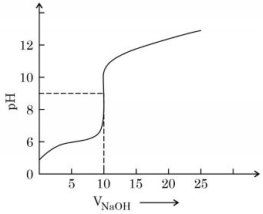
The number of following statements which is/are correct about phenolphthalein is $.....$.
$A$. It can be used as an indicator for the titration of weak acid with weak base.
$B$. It begins to change colour at $pH =8.4$
$C$. It is a weak organic base
$D$. It is colourless in acidic medium