Question
Four $ 12~\Omega $ resistances are connected in parallel. There such combinations are connected in series. What will be the total resistance ?

Answer

Four $ 12~\Omega $ resistances are connected (i) Parallel.
$ \Rightarrow \frac{1}{R_P} = \frac{1}{12} + \frac{1}{12} + \frac{1}{12} + \frac{1}{12} = \frac{4}{12} = \frac{1}{3} $
$ R_P = 3~\Omega $
Now, $ 3~\Omega $ resistances (3 in number) are connected in series.
$ \Rightarrow R_S = 3 + 3 + 3 = 9~\Omega $.

Need a full question paper?

Generate a complete, print-ready paper with questions like this in minutes — across 16+ boards, with answer keys.
Start Generating Free

Similar questions

What is interference ? Write the types of interference.
Given a uniform electric field $\overrightarrow{\text{E}} = 2 \times 10^3\ \hat{i}\  N/C$ find the flux of this field through a square of side $20 \ cm,$ whose plane is parallel to the $y-z$ plane. What would be the flux through the same square, if the plane makes an angle of $30^{\circ}$ with the$ x-$axis?
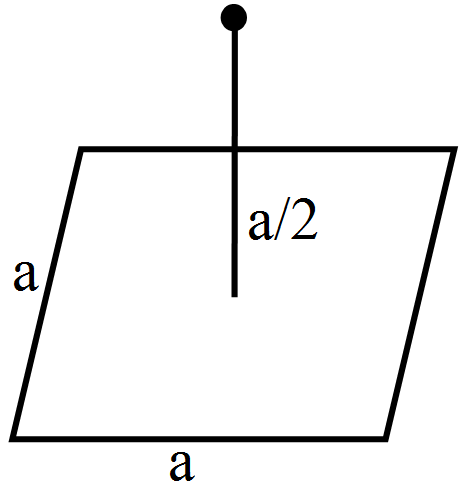
$A$ charge $Q$ is placed at a distance $\frac{\text{a}}{2}$ above the centre of a horizontal, square surface of edge a as shown in figure. Find the flux of the electric field through the square surface.
Two spheres A and B with radii $a$ and $b$ respectively are at the same potential. What will be the ratio of surface charge densities at $A$ and $B$ ?
A farsighted person cannot see objects placed closer to 50cm. Find the power of the lens needed to see the objects at 20cm.
What will be the effect on the magnetic flux associated with a coil located in any external magnetic field when
(i) Number of turns in the coil are increased?
(ii) Area of plane of the coil is increased?
(iii) Intensity of magnetic field of the coil is increased
A Kundt's tube apparatus has a steel rod of length 1.0m clamped at the centre. It is vibrated in its fundamental mode at a frequency of 2600Hz. The lycopodium powder dispersed in the tube collects into heaps separated by 6.5cm. Calculate the speed of sound in steel and in air.
The phenomenon of diffraction is commonly seen in sound waves. But generally not in light waves, why?
The earth revolves round the sun because the sun attracts the earth. The sun also attracts the moon and this force is 'about twice as large as the attraction of the earth on the moon. Why does the moon not revolve round the sun? Or does it?
Evaluate Rydberg constant by putting the values of the fundamental constants in its expression.