MCQ
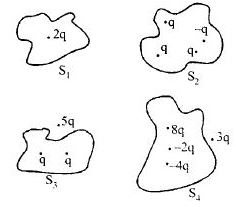
Four closed surfaces and corresponding charge distributions are shown below

Let the respective electric fluxes through the surfaces be ${\phi _1},{\phi _2},{\phi _3}$ and ${\phi _4}$ . Then
  • A
    ${\phi _1} < {\phi _2} = {\phi _3} > {\phi _4}$
  • B
    ${\phi _1} > {\phi _2} > {\phi _3} > {\phi _4}$
  • ${\phi _1} = {\phi _2} = {\phi _3} = {\phi _4}$
  • D
    ${\phi _1} > {\phi _3} ; {\phi _2} < {\phi _4}$
Answer

Correct option: C.
${\phi _1} = {\phi _2} = {\phi _3} = {\phi _4}$
c
The net fluw linked with closed surfaces $S_{1}$, $\mathrm{S}_{2}, \mathrm{S}_{3} \& \mathrm{S}_{4}$ are

For surface $S_{1}, \phi_{1}=\frac{1}{\varepsilon_{0}}(2 q)$

For surface

$\mathrm{S}_{2}, \phi_{2}=\frac{1}{\varepsilon_{0}}(\mathrm{q}+\mathrm{q}+\mathrm{q}-\mathrm{q})=\frac{1}{\varepsilon_{0}} 2 \mathrm{q}$

For surface $S_{3}, \phi_{3}=\frac{1}{\varepsilon_{0}}(q+q)=\frac{1}{\varepsilon_{0}}(2 q)$

For surface

$S_{4}, \phi_{4}=\frac{1}{\varepsilon_{0}}(8 q-2 q-4 q)=\frac{1}{\varepsilon_{0}}(2 q)$

Hence, $\phi_{1}=\phi_{2}=\phi_{3}=\phi_{4}$ i.e. netelectric flux is same for all surfaces.

Keep in mind, the electric field due to a charge outside $\left(\mathrm{S}_{3} \text { and } \mathrm{S}_{4}\right),$ the Gaussian surface contributes zero net flux through the surface, because as many lines due to that charge enter the surface as leave it.

Need a full question paper?

Generate a complete, print-ready paper with questions like this in minutes — across 16+ boards, with answer keys.

Start Generating Free

Similar questions

The ratio of the de-Broglie wavelengths of proton and electron having same kinetic energy:

(Assume $m_p=m_e \times 1849$ )

A particle slides from the top of a smooth hemispherical surface of radius $R$ which is fixed on a horizontal surface. If it separates from the hemisphere at a height $h$ from the horizontal surface, then the speed of the particle is
A spring of force constant $k$ is cut in two parts at its one third length. When both the parts are stretched by same amount, the work done in the two parts, will be
A uniformly thick wheel with moment of inertia $I$ and radius $R$ is free to rotate about its centre of mass (see fig). A massless string is wrapped over its rim and two blocks of masses $\mathrm{m}_{1}$ and $\mathrm{m}_{2}\left(\mathrm{m}_{1}>\mathrm{m}_{2}\right)$ are attached to the ends of the string. The system is released from rest. The angular speed of the wheel when $\mathrm{m}_{1}$ descents by a distance $h$ is
$A$ ray of sunlight enters a spherical water droplet $(n = 4/3)$ at an angle of incidence $53^o$ measured with respect to the normal to the surface. It is reflected from the back surface of the droplet and re-enters into air. The angle between the incoming and outgoing ray is.......$^o$ [Take $sin \,53^o = 0.8$]
Dimensions of potential energy are
What is the focal length of this curved surface ?........$cm$
Frosted glass is widely used for translucent windows. The region, where a transparent adhesive tape is stuck over the frosted glass becomes transparent. The most reasonable explanation for this is
A particle moves in space according to equation

$\vec r = (\sin \,t\,\hat i\, + \,\cos \,t\,\hat j\, + \,t\,\hat k)m$

Find time $'t'$ when position vector and acceleration vector are perpendicular to each other

A straight rod of length $L$ extends from $x = a$ to $x = L + a$. The gravitational force it exerts on a point mass $‘m’$ at $x = 0$, if the mass per unit length of the rod is $A + Bx^2$, is given by