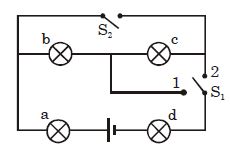
Four lamps are connected in the way shown in the figure. When switch $S_2$ is open and switch $S_1$ is on position $-2$ , lamp $-b$ is the brightest, and lamp $-c$ and lamp $-d$ are the dimmest and are of the same brightness. Now $S_2$ is closed and $S_1$ is on position $-1$ , the sequence in brightness of the lamps is (with the first in the sequence being the brightest)
Advanced
Download our app for free and get started
$\mathrm{S}_{2}$ is open and $\mathrm{S}_{1}$ is on position $-2$
$\mathrm{P}_{\mathrm{b}}$ is max
$\mathrm{P}_{\mathrm{c}}=\mathrm{P}_{\mathrm{d}}$
$\mathrm{P}=\mathrm{I}^{2} \mathrm{R}$
$\mathrm{P}_{\mathrm{b}}>\mathrm{P}_{\mathrm{a}}>\mathrm{P}_{\mathrm{c}}=\mathrm{P}_{\mathrm{d}}$
$\mathrm{R}_{\mathrm{b}}>\mathrm{R}_{\mathrm{a}}>\mathrm{R}_{\mathrm{c}}=\mathrm{R}_{\mathrm{d}}$
$\mathrm{S}_{2}$ is closed and $\mathrm{S}_{1}$ is on position $-$ $1$
${\rm{P}}_{\rm{b}}^\prime = \frac{{{\rm{V}}_0^2}}{{{{\rm{R}}_{\rm{b}}}}},{\rm{P}}_{\rm{c}}^\prime = \frac{{{\rm{V}}_0^2}}{{{{\rm{R}}_{\rm{c}}}}} \Rightarrow {\rm{P}}_{\rm{c}}^\prime > {\rm{P}}_{\rm{b}}^\prime $
$\mathrm{I}=\mathrm{I}_{1}+\mathrm{I}_{2}$
$\mathrm{P}_{\mathrm{a}}^{\prime}=\mathrm{I}^{2} \mathrm{R}_{\mathrm{a}}$
$\mathrm{P}_{d}^{\prime}=\mathrm{I}^{2} \mathrm{R}_{\mathrm{d}};$
Since $\mathrm{R}_{\mathrm{a}}>\mathrm{R}_{\mathrm{d}}$
$\mathrm{P}_{\mathrm{a}}^{\prime}>\mathrm{P}_{\mathrm{d}}^{\prime}$
$\mathrm{P}_{\mathrm{c}}^{\prime}=\mathrm{I}_{2}^{2} \mathrm{R}_{\mathrm{c}}=\left[\mathrm{I}\left(\frac{\mathrm{R}_{\mathrm{b}}}{\mathrm{R}_{\mathrm{b}}+\mathrm{R}_{\mathrm{c}}}\right)\right]^{2} \mathrm{R}_{\mathrm{c}}$
$P_{c}^{\prime}=I^{2}\left[\left(\frac{R_{c} R_{b}}{R_{c}+R_{b}}\right)^{2} \frac{1}{R_{c}}\right]$
$\left(\frac{\mathrm{R}_{\mathrm{c}} \mathrm{R}_{\mathrm{b}}}{\mathrm{R}_{\mathrm{c}}+\mathrm{R}_{\mathrm{b}}}\right)^{2}\left(\frac{1}{\mathrm{R}_{\mathrm{c}}}\right)<\mathrm{R}_{\mathrm{c}}=\mathrm{R}_{\mathrm{d}}$
$\mathrm{P}_{\mathrm{c}}^{\prime}<\mathrm{P}_{\mathrm{d}}^{\prime}$
$\mathrm{P}_{\mathrm{a}}^{\prime}>\mathrm{P}_{\mathrm{d}}^{\prime}>\mathrm{P}_{\mathrm{c}}^{\prime}>\mathrm{P}_{\mathrm{b}}^{\prime}$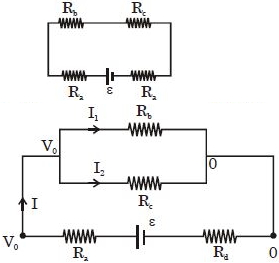

Download our appand get started for free
Experience the future of education. Simply download our apps or reach out to us for more information. Let's shape the future of learning together!No signup needed.*
Similar Questions
- 1View SolutionAcross a metallic conductor of non-uniform cross section a constant potential difference is applied. The quantity which remains constant along the conductor is
- 2If three resistors of resistance $2 \,\Omega$, $4 \,\Omega$ and $5 \,\Omega$ are connected in parallel then the total resistance of the combination will beView Solution
- 3Three bulbs of $40\,W$, $60\,W$ and $100\,W$ are arranged in series with $220\,V$. Which bulb has minimum resistance............... $W$View Solution
- 4If a $2\, kW$ boiler is used everyday for $1$ hour, then electrical energy consumed by boiler in thirty days is .......... $uint$View Solution
- 5Three resistors each of $2\, ohm$ are connected together in a triangular shape. The resistance between any two vertices will beView Solution
- 6Two light bulbs in the circuit have rating $A\,[24\ V, 48\,W]$ and $B\,[24\ V, 36\,W]$ as shown.View Solution
- 7$A$ simple circuit contains an ideal battery and a resistance $R$. If a second resistor is placed in parallel with the first,View Solution
- 8When a current of $2\, A$ flows in a battery from negative to positive terminal, the potential difference across it is $12\, V$. If a current of $3\, A$ flowing in the opposite direction produces a potential difference of $15\, V$, the $emf$ of the battery is .............. $V$View Solution
- 9For a metallic wire, the ratio $V/i$ ($V = $ the applied potential difference, $i$ = current flowing) isView Solution
- 10A potentiometer having the potential gradient of $2\, mV/cm$ is used to measure the difference of potential across a resistance of $10 \,\Omega$. If a length of $50\, cm$ of the potentiometer wire is required to get the null point, the current passing through the $10 \,\Omega$ resistor is (in $mA$)View Solution