MCQ
Four light waves are represented by
  • A
    (i) $y=a \sin \omega t$
  • B
    (ii) $y=a_2 \sin (\omega t+\phi)$
  • (iii) $y=a_1 \sin 2 \omega t$
  • D
    (iv) $y=a_2 \sin 2(\omega t+\phi)$

Answer

Correct option: C.
(iii) $y=a_1 \sin 2 \omega t$
(c) Fringe width $\beta \propto \lambda$. Therefore, $\lambda$ and hence $\beta$ decreases 1.5 times when immersed in liquid. The distance between central maxima and 10 maxima is $3 cm$ in vacuum. When immersed in liquid it will reduce to $2 cm$. Position of central maxima will not change while $10^*$ maxima will be obtained at $y=4 cm$.

Need a full question paper?

Generate a complete, print-ready paper with questions like this in minutes — across 16+ boards, with answer keys.
Start Generating Free

Similar questions

A rod of length $20 \mathrm{~cm}$ is rotating with angular speed of $100 \mathrm{rps}$ in a magnetic field of strength $0.5 T$ about it's one end. What is the potential difference between two ends of the rod
A $2 kg$ block is lying on a smooth table which is connected by a body of mass $1 kg$ by a string which passes through a pulley. The 1 $kg$ mass is hanging vertically. The acceleration of block and tension in the string will be
Two bodies of different masses $m_a$ and $m_b$ are dropped from two different heights $a$ and $b$. The ratio of the time taken by the two to cover these distances are
A double star is a system of two stars rotating about their centre of mass only under their mutual gravitational attraction. Let the star have mass $m$ and $2 m$ and their separation be $l$. Their time period of rotation about their centre of mass will be proportional to
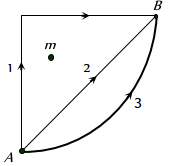
If $W_1, W_2$ and $W_3$ represent the work done in moving a particle from $A$ to $B$ along three different paths $1, 2$ and $3$ respectively $($as shown$)$ in the gravitational field of a point mass $\mathrm{m}$, find the correct relation between $W_1, W_2$ and $W_3$Image
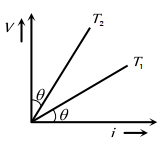
The $V$ - $i$ graph for a conductor at temperature $T_1$ and $T_2$ are as shown in the figure. $\left(T_2-T_1\right)$ is proportional to

Image

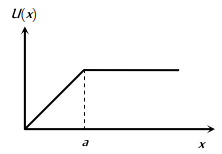
The potential energy of a system is represented in the first figure. the force acting on the system will be represented by
Image
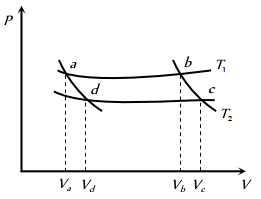
In the following $P-V$ diagram two adiabatics cut two isothermals at temperatures $T$ and $T$ (fig.). The value of $\frac{V_a}{V_d}$ will be
Image
Monochromatic light of frequency $5 \times 10^{14} \mathrm{~Hz}$ travelling in vacuum enters a medium of refractive index $1.5.$ Its wavelength in the medium is
If liquid level falls in a capillary then radius of capillary will