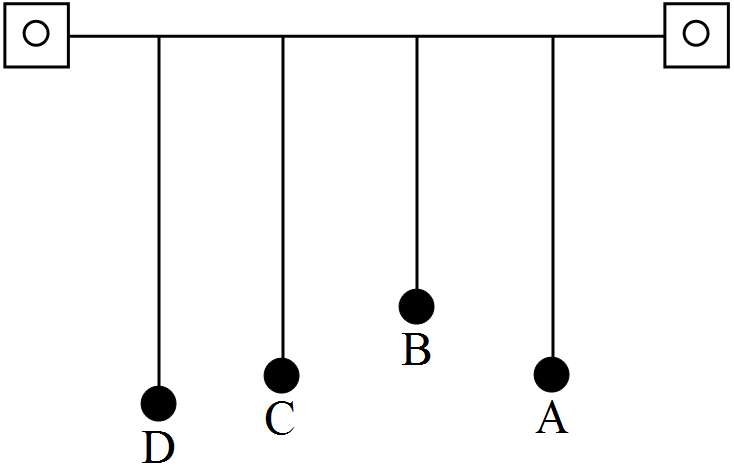
- D will vibrate with maximum amplitude.
- C will vibrate with maximum amplitude.
- B will vibrate with maximum amplitude.
- All the four will oscillate with equal amplitude.
Explanation:
Here A is given a transverse displacement. Through the elastic support the disturbance is transferred to all the pendulums.
A and C are having same length, hence they will be in resonance, because of their time period of oscillation. Since length of pendulums A and C is same and $\text{T}=2\pi\sqrt{\frac{\text{L}}{\text{g}}}$ hence their time period is same and they will have frequency of vibration. Due to it, a resonance will take place and the pendulum C will vibrate with maximum amplitude.
Generate a complete, print-ready paper with questions like this in minutes — across 16+ boards, with answer keys.

$(A)$ $\omega=\frac{3 v x}{ L ^2+3 x^2}$
$(B)$ $\omega=\frac{12 v x}{L^2+12 x^2}$
$(C)$ $x_M=\frac{L}{\sqrt{3}}$
$(D)$ $\omega_M=\frac{v}{2 L} \sqrt{3}$