Question
Four rods of same material and having the same cross section and length have been joined, as shown. The temperature of the junction of four rods will be ............... $^{\circ} C$

Answer

(c)

Incoming heat $=$ outgoing heat

$\left(90^{\circ}-\theta\right)+\left(60^{\circ}-\theta\right)=\theta-30^{\circ}+\theta-0^{\circ}$

$180^{\circ}=4 \theta$

$45^{\circ} C =\theta$

Need a full question paper?

Generate a complete, print-ready paper with questions like this in minutes — across 16+ boards, with answer keys.
Start Generating Free

Similar questions

The control rod in a nuclear reactor is made of
A positively charged ring is in $y-z$ plane with its centre at origin. A positive test charge $q_0$, held at origin is released along $x$-axis, then its speed
The ratio of two specific heats $\frac{{{C_P}}}{{{C_V}}}$ of $CO$ is
The relative error in the measurement of the side of a cube is $0.027$. The relative error in the measurement of its volume is .......... 
The-relation between the magnetic susceptibility and the magnetic permeability is
Two light waves of wavelengths $800$ and $600\,nm$ are used in Young's double slit experiment to obtain interference fringes on a screen placed $7\,m$ away from plane of slits. If the two slits are separated by $0.35\,mm$, then shortest distance from the central bright maximum to the point where the bright fringes of the two wavelength coincide will be $.............mm$.
Holes are charge carriers in
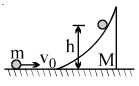
A particle of mass $m$ moving horizontally with $v_0$ strikes $a$ smooth wedge of mass $M$, as shown in figure. After collision, the ball starts moving up the inclined face of the wedge and rises to $a$ height $h$. Choose the correct statement(s) related to particle $m$ 
A charged gold leaf electroscope has its leaves apart by certain amount having enclosed air. When the electroscope is subjected to $X$-rays, then the leaves
A man is running at a speed of $5\, m/s$, the rain drops appear to be falling at an angle of $45^o$ from the vertical. If the rain drops are actually falling vertically downwards, then velocity of rain drops (in $m/s$) is