Question
Frictional force between solids operates even when they do not move with respect to each other. Do we have viscous force acting between two layers even if there is no relative motion?

Answer

No. For a liquid at rest, no viscous forces exist.
Viscous forces oppose relative motion between the layers of a liquid. These layers do not exist in a liquid that is at rest. Therefore, it is obvious that viscous forces are non-existent in a static liquid.

Need a full question paper?

Generate a complete, print-ready paper with questions like this in minutes — across 16+ boards, with answer keys.
Start Generating Free

Similar questions

Suppose that the electric field part of an electromagnetic wave in vacuum is $\text{E}=\{(3.1 \ \text{N}/\text{C}\cos[(1.8 \text{rad}/ \text{m}) \text{y}+(5.4\times10^6 \ \text{red}/\text{s}\text{t}]\hat{\text{i}}\}$.
  1. What is the direction of propagation?
  2. What is the wavelength λ ?
  3. What is the frequency ν ?
  4. What is the amplitude of the magnetic field part of the wave?
  5. Write an expression for the magnetic field part of the wave.
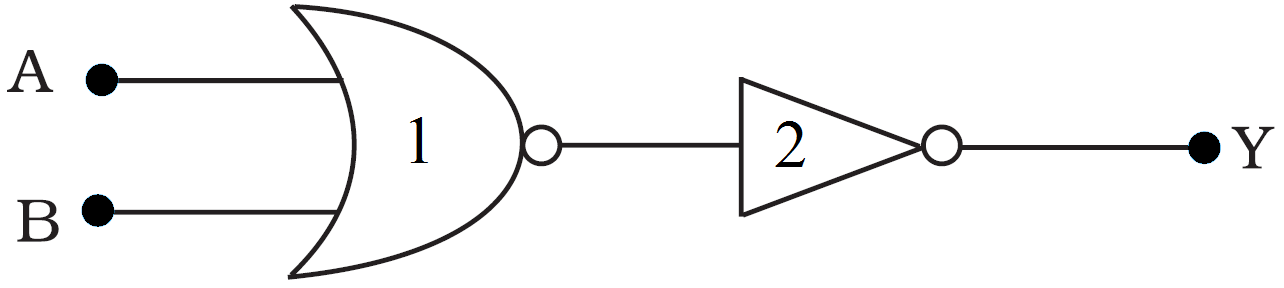
In the given logic circuit, name the logic gates 1 and 2 and write the name of the combination of gates.

Which orientation of an electric dipole in a uniform electric field would correspond to stable equilibrium?
What is the effect on the resistance due to increase in the temperature?
Can a tug of war be ever won on a frictionless surface?
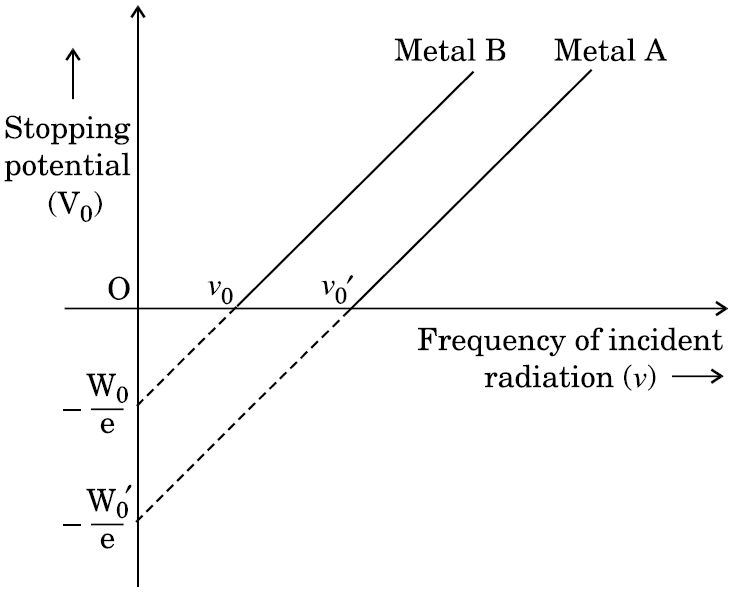
The graph shows the variation of stopping potential with frequency of incident radiation for two photosensitive metals A and B. Which one of the two has higher value of work-function? Justify your answer..

When a tiny circular obstacle is placed in the path of light from a distant source, a bright spot is seen at the center of the shadow of the obstacle. Explain why.
An electron, an alpha particle and a proton have the same kinetic energy. Which one of these particles has the largest de-Broglie wavelength?
When an electrical component $X$ is joined with any ac circuit, then current in it is ahead of phase of voltage by $\frac{\pi}{2}$ radian. Identify X and write an expression for its reactance.
Two particles A and B start from rest and move for equal time on a straight line. The particle A has an acceleration a for the first half of the total time and 2a for the second half. The particle B has an acceleration 2a for the first half and a for the second half. Which particle has covered larger distance?