Question
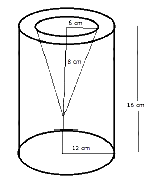
From a solid cylinder whose height is $16 \ cm$ and radius is $12 \ cm,$ a conical cavity of height $8 \ cm$ and of base radius $6 \ cm$ is hollowed out. Find the volume and total surface area of the remaining solid.
Answer


Radius of solid cylinder $(R) = 12 \ cm$
and Height $(H) = 16 \ cm$
$\therefore \text { Volume }=\pi R ^2 H$
$=\frac{22}{7} \times 12 \times 12 \times 16$
$=\frac{50688}{7} \ cm ^3$
Radius of cone $(r) = 6 \ cm,$ and height $(h) = 8 \ cm$.
$\therefore \text { Volume }=\frac{1}{3} \pi r ^2 h$
$=\frac{1}{3} \times \frac{22}{7} \times 6 \times 6 \times 8$
$=\frac{2112}{7} \ cm ^3$
$(1)$ Volume of remaining solid
$=\frac{50688}{7}-\frac{2112}{7}$
$=\frac{48567}{7}$
$=6939.43^2 \ cm ^3$
$(2)$ Slant height of cone $I =\sqrt{ h ^2+ r ^2}$
$=\sqrt{6^2+8^2}$
$=\sqrt{36+64}$
$=\sqrt{100}$
$=10 \ cm $
Therefore, total surface area of remaining solid $=$ curved surface area of cylinder $+$ curvedsurface area of cone $+$ base area of cylinder $+$ area of circular ring on upper side of cylinder
$=2 \pi RH +\pi rl +\pi R ^2+\pi\left( R ^2- r ^2\right)$
$=\left(2 \times \frac{22}{7} \times 12 \times 16\right)+\left(\frac{22}{7} \times 6 \times 10\right)+\left(\frac{22}{7} \times 12 \times 12\right)+\left(\frac{22}{7}\left(12^2-6^2\right)\right)$
$=\frac{8448}{7}+\frac{1320}{7}+\frac{3168}{7}+\frac{22}{7}(144-36)$
$=\frac{8448}{7}+\frac{1320}{7}+\frac{3168}{7}+\frac{2376}{7}$
$=\frac{15312}{7}$
$=2187.43 \ cm ^2$
 

Need a full question paper?

Generate a complete, print-ready paper with questions like this in minutes — across 16+ boards, with answer keys.
Start Generating Free

Similar questions

Find the fourth proportion to the following:
$(p^2q - qr^2 ), (pqr - pr^2 )$ and $(pq^2 - pr^2)$
A car covers a distance of $400\ km$ at a certain speed. Had the speed been $12\ km/h$ more, the time taken for the journey would have been $1$ hour $40$ minutes less. Find the original speed of the car.
A wire is in the form of a circle of radius 42 cm. It is bent into a square.
Determine the side of the square and compare the area of the regions enclosed in two cases.
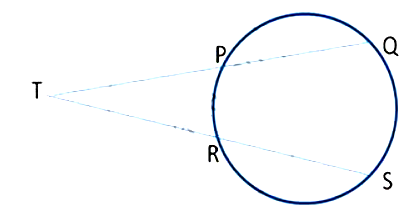
In fig. the centre of the circle is O. PQ and RS are two equal chords of the circle which , when produced , meet at T outside the circle . Prove that (a) TP = TR (b) TQ = TS.
Solve the following linear in-equation and graph the solution set on a real number line:
$\frac{1}{3}(2 x-1)<\frac{1}{4}(x+5)<\frac{1}{6}(3 x+4), x \in R$
The radius of a solid right circular cylinder increases by $20\%$ and its height decreases by $20\%$. Find the percentage change in its volume.
Prove the following identitie:
$\cot ^2 A\left(\frac{\sec A-1}{1+\sin A}\right)+\sec ^2 A\left(\frac{\sin A-1}{1+\sec A}\right)=0$
Given $f(x)=a x^2+b x+2$ and $g(x)=b x^2+a x+1$. If $x-2$ is a factor of $f(x)$ but leaves the remainder -15 when it divides $g(x)$, find the values of $a$ and $b$. With these values of $a$ and $b$, factorise the expression. $f(x)+g(x)+4 x^2+7 x$.
A $20 \ m$ high vertical pole and a vertical tower are on the same level ground in such a way that the angle of elevation of the top of the tower, as seen from the foot of the pole is $60^\circ$ and the angle of elevation of the top of the pole, as seen from the foot of the tower is $30^\circ$ . Find:
$(i)$ the height of the tower ;
$(ii)$ the horizontal distance between the pole and the tower.
$ABCD$ is a parallelogram where $A(x, y), B (5, 8), C (4, 7)$ and $D (2, -4).$ Find :
(i) co-ordinates of $A.$
(ii) equation of diagonal $BD$