MCQ
From left to right, $sp^2, sp^2, sp, sp$ hybridisation is present in
- ✓$C{H_2} = CH - C \equiv N$
- B$CH_2=C=CH-CH_3$
- C$HC \equiv C - C \equiv CH$
- D$CH \equiv C - CH = C{H_2}$
Generate a complete, print-ready paper with questions like this in minutes — across 16+ boards, with answer keys.
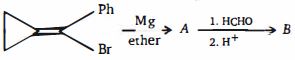
Which of the following is/are true about $\mathrm{A}^{\prime}, \mathrm{B}^{\prime}, \mathrm{C}^{\prime}$ and $\mathrm{D}^{\prime}$ ?
$A$. Order of atomic radii: $\mathrm{B}^{\prime}<\mathrm{A}^{\prime}<\mathrm{D}^{\prime}<\mathrm{C}^{\prime}$
$B$. Order of metallic character: $\mathrm{B}^{\prime}<\mathrm{A}^{\prime}<\mathrm{D}^{\prime}<\mathrm{C}^{\prime}$
$C$. Size of the element : $\mathrm{D}^{\prime}<\mathrm{C}^{\prime}<\mathrm{B}^{\prime}<\mathrm{A}^{\prime}$
$D$. Order of ionic radii : $\mathrm{B}^{\prime+}<\mathrm{A}^{\prime+}<\mathrm{D}^{\prime+}<\mathrm{C}^{\prime+}$
Choose the correct answer from the options given below :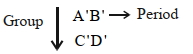
$\mathrm{A}(l) \rightarrow 2 \mathrm{B}(\mathrm{g})$
$\Delta \mathrm{U}=2.1\; \mathrm{kcal}, \Delta \mathrm{S}=20\; \mathrm{cal} \mathrm{K}^{-1}$ at $300\; \mathrm{K}$
Hence $\Delta \mathrm{G}$ in $\mathrm{kcal}$ is
$CH_3CH_2CH_2Br + NaCN \to $$CH_3CH_2CH_2CN+ NaBr$
This reaction will be the fastest in