MCQ
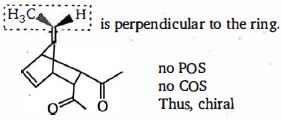
From the above compound $(A), (B), (C)$ & $(D)$ chiral compound is
  • $A$
  • B
    $B$
  • C
    $C$
  • D
    $D$

Answer

Correct option: A.
$A$
a
Plane of symmetry and centre of symmetry is not present in compound $(A)$  $\therefore$ it is chiral

Need a full question paper?

Generate a complete, print-ready paper with questions like this in minutes — across 16+ boards, with answer keys.

Start Generating Free

Similar questions

The orientation of an atomic orbital is governed by
Calculate the molecular weight of a substance whose $7.0\%$ by mass solution in water freezes at $-0.93\,^oC$ . The cryoscopic constant of water is $1.86\,^oC\,kg\,molal^{-1}$ ........... $g\,mol^{-1}$.
Assertion : trans-butene $-2$ on reaction with bromine forms racemic mixture.

Reason : trans-Compound in trans addition forms two types of stereoisomers.

Number of structural isomers of $C_3H_6O$
$E.C.E.$ of Cu and Ag are $7 \times {10^{ - 6}}$ and $1.2 \times {10^{ - 6}}.$A certain current deposits $14\, gm$ of $Cu$. Amount of $Ag$ deposited is .............. $\mathrm{gm}$
The number of species from the following which are paramagnetic and with bond order equal to one is___________

$\mathrm{H}_2, \mathrm{He}_2^{+}, \mathrm{O}_2^{+}, \mathrm{N}_2^{2-}, \mathrm{O}_2^{2-}, \mathrm{F}_2, \mathrm{Ne}_2^{+}, \mathrm{B}_2$

In the given reaction 

$\begin{array}{*{20}{c}}
  {O\,\,\,\,\,\,\,\,\,} \\ 
  {||\,\,\,\,\,\,\,\,\,\,} \\ 
  {C{H_3} - C{H_2} - C - C{H_2}COO{C_2}{H_5}} 
\end{array}\xrightarrow{{[X]\,}}(A)$$ \mathop {\xrightarrow{{(i)\,LiAl{H_4}\,}}}\limits_{(ii)\,{H_2}O/{H^ \oplus }} \begin{array}{*{20}{c}}
  {O\,\,\,\,\,\,\,\,\,} \\ 
  {||\,\,\,\,\,\,\,\,\,\,} \\ 
  {C{H_3} - C{H_2} - C - C{H_2} - C{H_2}OH} 
\end{array} + \,{C_2}{H_5}OH$

$[X]$ will be :

A mixture of ammonia and air at about ${800\,^o}C$ in the presence of $Pt$ gauze forms
The number of $\pi - {\rm{bonds}}$ in the product formed by passing acetylene through dilute sulphuric acid containing mercuric sulphate is
During the change of $O _{2}$ to $O _{2}^{-}$, the incoming electron goes to the orbital :