MCQ
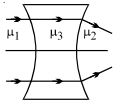
From the figure shown establish a relation between, $\mu_1, \mu_2, \mu_3.$
  • A
    $\mu_1 < \mu_2 < \mu_3$
  • $\mu_3 < \mu_2 ; \mu_3 = \mu_1$
  • C
    $\mu_3 > \mu_2 ; \mu_3 = \mu_1$
  • D
    None of these

Answer

Correct option: B.
$\mu_3 < \mu_2 ; \mu_3 = \mu_1$
b
Between $1$ and $3 $there is no deviation. Hence,

$\mu_{1}=\mu_{3}$

Between $3$ and $2$

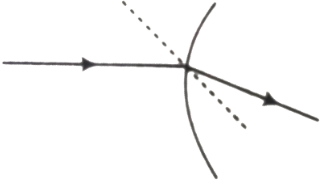
Ray to light binds towards normal. Hence,

$\mu_{2}>\mu_{3}$
Need a full question paper?

Generate a complete, print-ready paper with questions like this in minutes — across 16+ boards, with answer keys.
Start Generating Free

Similar questions

A projectile of mass $1\,\, kg$ is projected with a velocity of $\sqrt {20} \,\,m/s$ such that it strikes on the same level as the point of projection at a distance of $\sqrt {3} \,\,m$. Which of the following options are incorrect:
The energy stored in a condenser is in the form of
The self inductance of a choke coil is $10\, mH$. When it is connected with a $10\,V$ $dc$ source, then the loss of power is $20 \,watt$. When it is connected with $10\, volt$ $ac$ source loss of power is $10 \,watt$. The frequency of $ac$ source will be.......$Hz$
Two masses $8\; kg$ and $12\; kg$ are connected at the two ends of a light inextensible string that goes over a frictionless pulley. Find the acceleration of the masses, and the tension in the string when the masses are released.
An open pipe is in resonance in its $2^{nd}$ harmonic with tuning fork of frequency ${f_1}$. Now it is closed at one end. If the frequency of the tuning fork is increased slowly from ${f_1}$ then again a resonance is obtained with a frequency ${f_2}$. If in this case the pipe vibrates ${n^{th}}$ harmonics then
The grinding stone of a flour mill is rotating at $600\, rad/sec$. for this power of  $1.2\, k\, watt$ is used. the effective torque on stone in $N-m$ will be
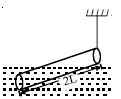
A slender homogeneous rod of length $2L$ floats partly immersed in water, being supported by a string fastened to one of its ends, as shown. The specific gravity of the rod is $0.75$. The length of rod that extends out of water is : 
Two spherical bodies $\mathrm{A}$ (radius $6 \mathrm{~cm}$ ) and $\mathrm{B}$ (radius $18 \mathrm{~cm}$ ) are at temperature $\mathrm{T}_1$ and $\mathrm{T}_2$, respectively. The maximum intensity in the emission spectrum of $\mathrm{A}$ is at $500 \mathrm{~nm}$ and in that of $\mathrm{B}$ is at $1500 \mathrm{~nm}$. Considering them to be black bodies, what will be the ratio of the rate of total energy radiated by $A$ to that of $B$ ?
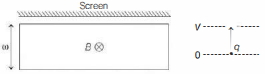
A rectangular region of dimensions ( $\omega \times l(\omega) \ll l$ ) has a constant magnetic field into the plane of the paper as shown in the figure below. On one side, the region is bounded by a screen. On the other side, positive ions of mass $m$ and charge $q$ are accelerated from rest and towards the screen by a parallel plate capacitor at constant potential difference $V < 0$ and come out through a small hole in the upper plate. Which one of the following statements is correct regarding the charge on the ions that hit the screen?
Two charges $ + 3.2 \times {10^{ - 19}}$ and $ - 3.2 \times {10^{ - 19}}\,C$ placed at $2.4\,{\mathop A\limits^o }$ apart form an electric dipole. It is placed in a uniform electric field of intensity $4 \times {10^5}\,volt/m$. The electric dipole moment is