Question
From the following data state which frequency distribution is close to symmetry.:
Frequency distribution $\mathrm{A}: \bar{x}=40, M=44, S=15$
Frequency distribution $\mathrm{B}: x=40, M=45, s=16$

Answer

Frequency distribution $\mathrm{A}: \mathrm{j}=-0.8 ;$
Frequency distribution $\mathrm{B}: \mathrm{j}=-0.94$,
Frequency distribution $\mathrm{A}$ is close to symmetry.

Need a full question paper?

Generate a complete, print-ready paper with questions like this in minutes — across 16+ boards, with answer keys.

Start Generating Free

Similar questions

Explain skewness and coefficient of skewness.
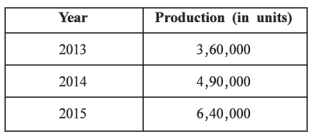
The data on the production of an industrial unit during three years is as under. Present it by using circle diagram.
Obtain the value of $(\sqrt{7}+1)^{3}-(\sqrt{7}-1)^{3}$ using binomial expansion method.
For a $G.P.$ if $T_{3}=4$ and $T_{5}=16$, find its common ratio and the first term.
Calculate the standard deviation from the following frequency distribution of marks obtained by $200$ students of a school in an examination :
Discuss advantages and disadvantages of indirect Inquiry.
Find the maximum value of n such that the sum of the first $11$ terms of a $G. P. 2, 4, 8, 16 ......$ does not exceed $5000.$
The area of $50$ plots (in sq. mt.) In an agriculture inquiry are as follows:
$\text{2360, 1090, 2000, 3005, 2773, 850, 1625, 2292, 2168, 2550, 6166, 2900, 1898, 700, 1785,2110, 2230, 2600, 3170, 2495, 1122, 3500, 7272, 968, 1290, 2010, 2700, 4590, 1170, 1100,2055, 760, 2390, 4700, 1995, 1380, 2512, 1570, 3672, 1268, 2175, 2400, 3200, 1800, 2660, 2865, 5575, 1440, 2300, 2695}.$
From the above information prepare a frequency distribution by taking class length $300$ for two initial classes, thereafter next four classes with class length $500$ and the rest of the classes with class length $1500$.
The mean and $S.d.$ of $50$ observations are respectively $30$ and $10$. In the calculation, two observations were taken $7$ and $3$ instead of $- 7$ and $- 9$, find the true values of mean and $S.d.$
With the help of binomial expansion show that, $(x+$ $1)^{5}-5(x+1)^{4}+10(x+1)^{3}-10(x+1)^{2}+$ $5(x+1)-1=x^{5}$