MCQ
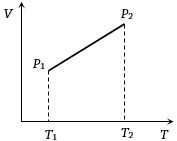
From the following $V-T$ diagram we can conclude
  • A
    $P_1 = P_2$
  • $P_1 > P_2$
  • C
    $P_1 < P_2$
  • D
    None of these

Answer

Correct option: B.
$P_1 > P_2$
b
(b) In case of given graph, $V$ and $T$ are related as $V = aT – b$, where $a$ and $b$ are constants.

From ideal gas equation, $PV = \mu RT$

We find $P = \frac{{\mu RT}}{{aT - b}} = \frac{{\mu R}}{{a - b/T}}$

Since $T_2 > T_1$, therefore $P_2 < P_1$.

Need a full question paper?

Generate a complete, print-ready paper with questions like this in minutes — across 16+ boards, with answer keys.
Start Generating Free

Similar questions

Three vectors $\vec{\text{A}},\ \vec{\text{B}}$ and $\vec{\text{C}}$ add up to zero. Find which is false.
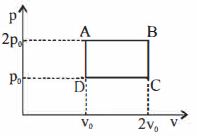
The above $P-V$ diagram represents the thermodynamic cycle of an engine, operating with an ideal monatomic gas. The amount of heat, extracted from the source in a single cycle is
A man measures time period of a pendulum $(T)$ in stationary lift. If the lift moves upward with acceleration $\frac{g}{4},$ then new time period will be
A particle is made to move from the origin in three spells of equal distances, first along the $x-axis$ , second parallel to $y-axis$ and third parallel to $z-axis$ . One of the forces acting on it is has constant magnitude of $50\  N$ and always acts along the direction of motion. Work done by this force in the three spells of motion are equal and total work done in all the three spells is $300\ J$ . The final coordinates of the particle will be
The height of a waterfall is $84$ metre. Assuming that the entire kinetic energy of falling water is converted into heat, the rise in temperature of the water will be  $(g = 9.8\,m/{s^2},\;J = 4.2\,joule/cal)$
Let $[{\varepsilon _0}]$ denotes the dimensional formula of the permittivity of the vacuum and $[{\mu _0}]$ that of the permeability of the vacuum. If $M = {\rm{mass}}$, $L = {\rm{length}}$, $T = {\rm{Time}}$ and $I = {\rm{electric current}}$, then
Following statements are given for a stationary wave

$(a)$ Every particle has a fixed amplitude which is different from the amplitude of its nearest particle.

$(b)$ All the particles cross their mean position at the same time.

$(c)$ All the particles are oscillating with same amplitude.

$(d)$ There is no net transfer of energy across any plane.

$(e)$ There are some particles which are always at rest.

Which of the following is correct
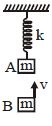
Block $A$ is hanging from a vertical spring and it is at rest. Block $'B'$ strikes the block $'A'$ with velocity $v$ and stick to it. Then the velocity $v$ for which the spring just attains natural length is:
If the resultant of $n$ forces of different magnitudes acting at a point is zero, then the minimum value of $n$ is
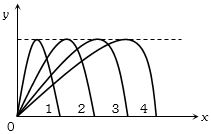
Figure shows four paths for a kicked football. Ignoring the effects of air on the flight, rank the paths according to initial horizontal velocity component, highest first