MCQ
From which Newton's law the other two laws can be derived?
  • A
    First to second and third
  • First and third from second
  • C
    Third to first and second
  • D
    The above statement is impossible

Answer

Correct option: B.
First and third from second
B

Need a full question paper?

Generate a complete, print-ready paper with questions like this in minutes — across 16+ boards, with answer keys.
Start Generating Free

Similar questions

When vector $\overrightarrow{ A }=2 \hat{ i }+3 \hat{ j }+2 \hat{ k }$ is subtracted from vector $\vec{B}$, it gives a vector equal to $2 \hat{j}$. Then the magnitude of vector $\vec{B}$ will be:
The energy stored in wound watch spring is
A black body is at $727^\circ C.$ It emits energy at a rate which is proportional to:
The centre of mass of system of particles does not depend on
In an electric circuit containing a battery, the charge (assumed positive) inside the battery:
A car of mass $m$ starts from rest and accelerates so that the instantaneous power delivered to the car has a constant magnitude $P_0$. The instantaneous velocity of this car is proportional to
If the sun and the planets carried huge amounts of opposite charges,
  1. All three of Kepler’s laws would still be valid.
  2. Only the third law will be valid.
  3. The second law will not change.
  4. The first law will still be valid.
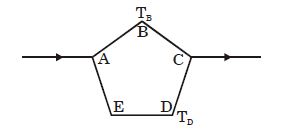
$ABCDE$ is a regular pentagon of uniform wire. The rate of heat entering at $A$ and leaving at $C$ is equal. $T_B$ and $T_D$ are temperature of $B$ and $D$ . Find the temperature $T_C$
A gas at ${27}^\circ C$ temperature and $30$ atmospheric pressure is allowed to expand to the atmospheric pressure. If the volume becomes $10$ times its initial volume, then the final temperature becomes ...... $^oC$
The radiation emitted by a star $A$ is $10,000$ times that of the sun. If the surface temperatures of the sun and the star $A$ are $6000 K$ and $2000 K$ respectively, the ratio of the radii of the star $A$ and the sun is