MCQ
Froth flotation is a process of $.......$
  • A
    Oxidation.
  • B
    Reduction.
  • C
    Refining.
  • Concentration.

Answer

Correct option: D.
Concentration.
Froth flotation is a process of concentration. Froth floatation process is suitable for sulphide ores It is based on the difference in wetting properties of the ore and gangue with water and oil.

Need a full question paper?

Generate a complete, print-ready paper with questions like this in minutes — across 16+ boards, with answer keys.
Start Generating Free

Similar questions

Which of the following substance is stored under water:
In which of the following reaction, product are not correctly matched
The acid used in lead storage cells is
The number of stereoisomers possible for $\left[ Co ( ox )_{2}( Br )\left( NH _{3}\right)\right]^{2-}$ is ...... . $[ ox =$ oxalate $]$
Which of the following is not a target molecule for drug function in body?
The conversion of hydroxyapatite occurs due to presence of $\mathrm{F}^{-}$ions in water. The correct formula of hydroxyapatite is:
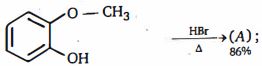
Product $(A)$ of this reaction is
An optically active alcohol of formula $C_9H_{12}O_2$ produced the following  compound when refluxed with $KMnO_4$

What is structure of $(A)$ ?

The original compound showed these properties also :

$\mathop {{C_9}{H_{12}}{O_2}}\limits_{(A)} \,\xrightarrow{{Na}}\,{H_2}$  liberated

$\mathop {{C_9}{H_{12}}{O_2}}\limits_{(A)} \,\xrightarrow{{Br}}$  no rapid reaction

$\mathop {{C_9}{H_{12}}{O_2}}\limits_{(A)} \,\xrightarrow[{cool}]{{Cr{O_3}\,/\,{H^ + }}}{C_9}{H_8}{O_3}$

To deposit one litre of hydrogen at $22.4$ atmosphere from acidulaled water, the quantity of electricity that must pass through is ............. $\mathrm{coulomb}$
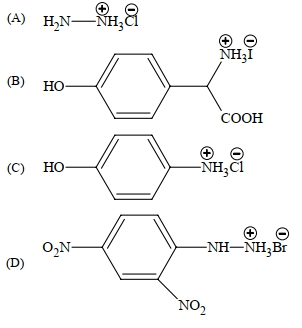
Match the compounds in Column $I$ with their characteristic test $(s)$ reaction $(s)$ given in Column $II$. Indicate your answer by darkening the appropriate bubbles of the $4 \times 4$ matrix gives in the $ORS$.
Column $I$ Column $II$
$Image$ $(p)$ sodium fusion extract of the compound gives Prussian blue colour with $\mathrm{FeSO}_4$
$Image$ $(q)$ gives positive $\mathrm{FeCl}_3$ test
$Image$ $(r)$ gives white precipitate with $\mathrm{AgNO}_3$
$Image$ $(s)$ reacts with aldehydes to form the corresponding hydrazone derivative