MCQ
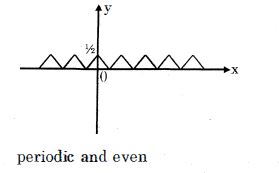
Function $f(x) = {\left( {\left\{ x \right\} - \frac{1}{2}} \right)^2}$ is (where $\{.\}$ represents fractional part function)
  • A
    discontinuous
  • B
    always differentiable
  • C
    non-periodic
  • even

Answer

Correct option: D.
even
d

Need a full question paper?

Generate a complete, print-ready paper with questions like this in minutes — across 16+ boards, with answer keys.

Start Generating Free

Similar questions

Let a unit vector $\hat{\mathrm{t}}=\mathrm{x} \hat{\mathrm{i}}+\mathrm{y} \hat{\mathrm{j}}+\mathrm{z} \hat{\mathrm{k}}$ make angles $\frac{\pi}{2}, \frac{\pi}{3}$ and $\frac{2 \pi}{3}$ with the vectors $\frac{1}{\sqrt{2}} \hat{\mathrm{i}}+\frac{1}{\sqrt{2}} \hat{\mathrm{k}}, \frac{1}{\sqrt{2}} \hat{\mathrm{j}}+\frac{1}{\sqrt{2}} \hat{\mathrm{k}}$ and $\quad \frac{1}{\sqrt{2}} \hat{\mathrm{i}}+\frac{1}{\sqrt{2}} \hat{\mathrm{j}} \quad$ respectively. If $\overrightarrow{\mathrm{v}}=\frac{1}{\sqrt{2}} \hat{\mathrm{i}}+\frac{1}{\sqrt{2}} \hat{\mathrm{j}}+\frac{1}{\sqrt{2}} \hat{\mathrm{k}}$, then $|\hat{\mathrm{u}}-\overrightarrow{\mathrm{v}}|^2$ is equal to
In a box containing 100 bulbs, 10 are defective. What is the probability that out of a sample of 5 bulbs, none is defective?

  1. $\big(\frac{9}{10}\big)^5$

  2. $\frac{9}{10}$

  3. $10^{-5}$

  4. $\big(\frac{1}{2}\big)^2$

Which of the following equation is non-linear
Let $S_n=\sum_{k=1}^n \frac{n}{n^2+k n+k^2}$ and $T_n=\sum_{k=0}^{n-1} \frac{n}{n^2+k n+k^2}$ for $n=1,2,3, \ldots$ Then,

$(A)$ $\mathrm{S}_{\mathrm{n}}<\frac{\pi}{3 \sqrt{3}}$ $(B)$ $S_n>\frac{\pi}{3 \sqrt{3}}$

$(C)$ $T_n<\frac{\pi}{3 \sqrt{3}}$ $(D)$ $T_n>\frac{\pi}{3 \sqrt{3}}$

Let $\mathrm{f}: N \rightarrow N$ be a function such that $\mathrm{f}(\mathrm{m}+\mathrm{n})=\mathrm{f}(\mathrm{m})+\mathrm{f}(\mathrm{n})$ for every $\mathrm{m}, \mathrm{n} \in N$. If $\mathrm{f}(6)=18$ then $\mathrm{f}(2) \cdot \mathrm{f}(3)$ is equal to :
Let $f(x) = [2x^3 -5];$ then number of points in $(1, 2)$ where the function is discontinuous are where $[\,.]\, \to G.I.F$
For the function $ f (x) =$ $\mathop {Lim}\limits_{n \to \infty } \,\,\frac{1}{{1 + n{{\sin }^2}(\pi x)}}$ , which of the following holds ?
Let $f(\theta ) = \sin \theta (\sin \theta + \sin 3\theta )$, then $f(\theta )$
If $A=\left[\begin{array}{cc}\cos \alpha & -\sin \alpha \\ \sin \alpha & \cos \alpha\end{array}\right]$ and $A+A^{\prime}=I$ then $\alpha=$ _________.
If A and B are two independent events with $\text{P(A)}=\frac{3}{5}$ and $\text{P(B)}=\frac{4}{9},$ then $\text{P}(\overline{\text{A}}\cap\overline{\text{B}})$ equals,