MCQ
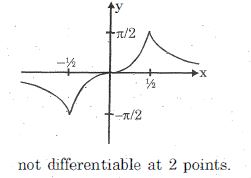
Function $f(x) = {\sin ^{ - 1}}\left( {3x - 4{x^3}} \right)$ is
  • A
    always difierentiable
  • not differentiable at $2$ points
  • C
    not continuous at $2$ points
  • D
    not differentiable at $3$ points

Answer

Correct option: B.
not differentiable at $2$ points
b

Need a full question paper?

Generate a complete, print-ready paper with questions like this in minutes — across 16+ boards, with answer keys.

Start Generating Free

Similar questions

Let $A$ be a set consisting of $10$ elements. The number of non-empty relations from $A$ to $A$ that are reflexive but not symmetric is
The value of $\int_{\, - \,\pi }^{\,\pi } {\frac{{{{\cos }^2}x}}{{1 + {a^x}}}dx,\,a > 0,} $ is
The function $\text{f(x)}=4\sin^3\text{x}-6\sin^2\text{x}+12\sin\text{x}+100$ is strictly :
The maximum value of $\triangle=\begin{vmatrix}1&1&1\\1&1+\sin\theta&1\\1+\cos\theta&1&1\end{vmatrix}$ is $(\theta$ is real$):$
Let $\vec{b}=\hat{i}+\hat{j}+\lambda \hat{k}, \lambda \in R$. If $\vec{a}$ is a vector such that $\overrightarrow{ a } \times \overrightarrow{ b }=13 \hat{ i }-\hat{ j }-4 \hat{ k } \quad$ and $\quad \overrightarrow{ a } \cdot \overrightarrow{ b }+21=0$, then $(\vec{b}-\vec{a}) \cdot(\hat{k}-\hat{j})+(\vec{b}+\vec{a}) \cdot(\hat{i}-\hat{k})$ is equal to
The function $\text{f{x}}\begin{cases}1,&|\text{x}|\geq1\\\frac{1}{\text{n}^2},&\frac{1}{\text{n}}<|\text{x}|<\frac{1}{\text{n}-1},\text{n}=2,3,...\end{cases}$
The equation of a line passing through the point $(-3,2,-4)$ and equally inclined to the axes are
Let $f: R \rightarrow R$ be defined as $f(x)=e^{-x} \sin x$. If $F :[0,1] \rightarrow R$ is a differentiable function such that $F ( x )=\int_{0}^{ x } f ( t ) dt ,$ then the value of $\int_{0}^{1}\left( F ^{\prime}( x )+ f ( x )\right) e ^{ x } dx$ lies in the interval
Let $\vec{a}=2 \hat{i}+5 \hat{j}-\hat{k}, \vec{b}=2 \hat{i}-2 \hat{j}+2 \hat{k}$ and $\overrightarrow{\mathrm{c}}$ be three vectors such that $(\vec{c}+\hat{i}) \times(\vec{a}+\vec{b}+\hat{i})=\vec{a} \times(\vec{c}+\hat{i}) \cdot \vec{a} \cdot \vec{c}=-29$, then $\overrightarrow{\mathrm{c}} \cdot(-2 \hat{\mathrm{i}}+\hat{\mathrm{j}}+\hat{\mathrm{k}})$ is equal to :
The solution of $\frac{{{d^2}y}}{{d{x^2}}} = \cos x - \sin x$is