Question
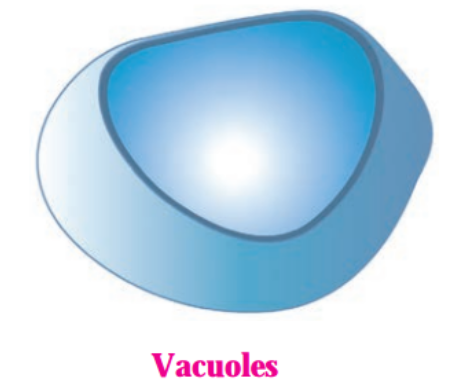
Functions of : Vacuole.
Image

Answer

  1. Vacuoles maintain the osmotic pressure of the cell.
  2. Various metabolic byproducts and end products such as glycogen, proteins, water, etc. are stored in the lysosome.
  3. In food vacuole of amoeba, the food is temporarily stored till digestion. In other animal cells, vacuoles can store waste products and food.
  4. Vacuoles of plant cells can provide turgidity and rigidity as it contains good amount of cell sap.

Need a full question paper?

Generate a complete, print-ready paper with questions like this in minutes — across 16+ boards, with answer keys.
Start Generating Free

Similar questions

Why do some people have earache when they travel by an aeroplane?
What is reflection of light?
State the factors on which the buoyant force depends.
Carbon dioxide reacts with sodium hydroxide.(Explain With Balanced Equation)
Classify the following changes into physical and chemical change. Ripening of mango, melting of ice, boiling of water, dissolution of salt in water, Ripening of banana, fragrance on ripening fruit, darkening of a cut potato, bursting of an inflated balloon, sound of bursting fire cracker, foul smell from a portion of spoiled food.
How many plastic carry bags are brought in your home in a day? What happens to those later on?
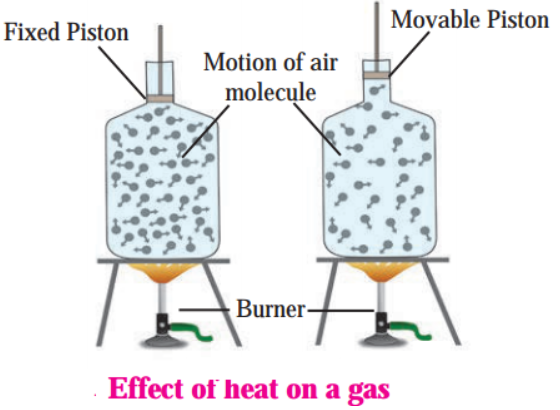
A gas does not even have a fixed volume. Gas expands on heating but if the gas is kept in a closed box, its volume cannot increase but its pressure increases. This is shown in Fig. Observe Fig. and find out answers to the questions.

Image
(1)Using the formula density = mass/volume, explain what will be the effect of heat on the gas kept in a closed bottle.
(2)If the bottle is not closed but has a movable piston attached to its open end (see the figure), what will be the effect of heating the gas in the bottle?

The mass of a tile is 500 g . If the density of the tile is $2.5 g / cm ^3$, what will be the weight of the tile when it is completely immersed in water?
$\left(g=9.8 m / s^2, \rho(\text { water })=1000 kg / m^3\right)$
Why does it happen? The wall of a dam is broad at its base.
A metal block has thmensions $10 cm \times 5 cm \times 2 cm$ and the density of the metal is $8 \times 10^3 kg / m ^3$. It is kept on a table with the face $10 cm \times 5 cm$ in contact with the table. Find the force and pressure exerted by the block on the table. $\left(g=9.8 m / s ^2\right)$