MCQ
Fusion reaction is also known as ..........:
- AChemical reaction
- BElastic reaction
- CThermonuclear reaction
- DPhotonuclear reaction
Explanation:
In nuclear physics,nuclear fusion is a nuclear reaction in which two or more atomic nuclei collide at very high speed and join to form a new type of atomic nucleus. During this process matter is not conserved because some of the matter of fusing nuclei is converted to photons also known as thermonuclear reaction.
Generate a complete, print-ready paper with questions like this in minutes — across 16+ boards, with answer keys.
The characteristic X-ray radiation is emitted, when
| (a) The electrons are accelerated to a fixed energy |
| (b) The source of electrons emits a monoenergetic beam |
|
(c) The bombarding electrons knock out electrons from the inner shell of the target atoms and one of the outer electrons falls into this vacancy |
|
(d) The valence electrons in the target atoms are removed as a result of the collision |
Complete the reaction 
(a) 
|
(b) 
|
(c) 
|
(d) 
|
In an experiment, a graph was plotted of the potential difference V between the terminals of a cell against the circuit current i by varying load rheostat. Internal conductance of the cell is given by
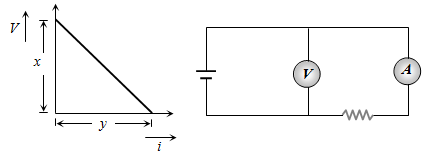
|
(a) xy |
(b) |
(c) |
(d) (x – y) |
Particles having positive charges occasionally come with high velocity from the sky towards the earth. On account of the magnetic field of earth, they would be deflected towards the
|
(a) North |
(b) South |
(c) East |
(d) West |
A voltmeter of resistance 1000 Ω gives full scale deflection when a current of 100 mA flow through it. The shunt resistance required across it to enable it to be used as an ammeter reading 1 A at full scale deflection is
|
(a) 10000 Ω |
(b) 9000 Ω |
(c) 222 Ω |
(d) 111 Ω |

