Question
Fusion reaction takes place at very high temperature because$:$

Answer

Fusion reactions takes place at temperature about $10^7K$ it requires this high temperature so that nucleus are moving at very high speed, so that they have high kinetic energy and can overcome the repulsion between nuclei and come together.

Need a full question paper?

Generate a complete, print-ready paper with questions like this in minutes — across 16+ boards, with answer keys.
Start Generating Free

Similar questions

If an electron moves from rest from a point at which potential is $50$ volt to another point at which potential is $70$ volt, then its kinetic energy in the final state will be
A freshly prepared radioactive source of half life 2 hr emits radiation of intensity which is 64 times the permissible safe level. The minimum time after which it would be possible to work safely with this source is:
The work function of aluminium is 4.2 eV.If two photons each of energy 3.5 eV strike an electron of aluminium, then emission of electrons will be:
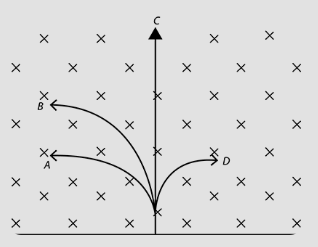
A neutron, a proton, an electron and an α−particle enter a region of uniform magnetic field with equal velocities. The magnetic field is perpendicular to the plane of paper and directed into it. The tracks of particles are labeled in the figure. The neutron follows the track:
In an astronomical microscope, the focal length of the objective is made:
An electron and a proton are both released from rest 1 meter from a large stationary negative charge, considering only the force from the large stationary negative charge on the proton and electron. Which of the following is true?
What is the value of inductance L for which the current is a maximum in a series LCR circuit with $\text{C}=10\mu\text{F}$ and $\omega=1000_\text{s}^{-1}$?
Stopping potential for photoelectrons(a) Does not depend on the frequency of the incident light(b) Does not depend upon the nature of the cathode material(c) Depends on both the frequency of the incident light and nature of the cathode material(d) Depends upon the intensity of the incident light


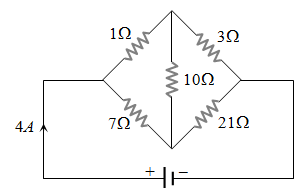
In the circuit shown in figure, the current drawn from the battery is $4A.$  If $10\Omega$ resistor is replaced by $20\Omega$ resistor, then current drawn from the circuit will be
Potential at a point $x-$distance from the centre inside the conducting sphere of radius $R$ and charged with charge $Q$ is