Question
$f(x) = \frac{1}{x+1}, x \neq -1$

Answer

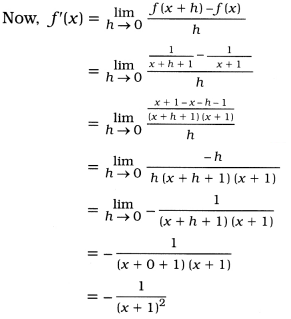
Here, $f(x) = \frac{1}{x+1}$
$\therefore f(x + h) = f(x)$

Hence, $f(x) = \frac{1}{x+1}$ then $f'(x) = -\frac{1}{(x+1)^{2}}$.

Need a full question paper?

Generate a complete, print-ready paper with questions like this in minutes — across 16+ boards, with answer keys.
Start Generating Free

Similar questions

$8$ workers are employed in a factory and $3$ of them are excellent in efficiency where as the rest of them are moderate in efficiency. $2$ workers are randomly selected from these $8$ workers. Find the probability that $(1)$ both the workers have excellent efficiency $(2)$ both the workers have moderate efficiency $(3)$ one worker is excellent and one worker is moderate in efficiency.
Two variables $X$ and $Y$ are mutually dependent variables, $\Sigma(x-\bar{x})(y-\bar{y})=$ $-200, n S_{x}^{2}=125 ; n S_{y}^{2}=500$, find $b_{y n}$
$\lim _{x \rightarrow 4} \frac{\sqrt{x+5}-3}{4-\sqrt{x+12}}$
Two balanced dice are thrown simultaneously. Find the probability that the sum of numbers on two dice is a multiple of $2$ or $3 .$
One card is selected at random from a pack of $52$ cards
Find the probability that the selected card is
$(1)$ A spade or a jack.
$(2)$ Neither a spade nor a jack.
Find $\frac{d y}{d x}$ if $(2 x+3)(y+2)=15$.
State the properties of normal distribution.
For two events $A$ and $B$ of the sample space of a random experiment, $2 P(A)=3 P(B)=4 P(A \cap B)=0.6$. Obtain the probabilities for the following events.
$(1)\ \left(A^{\prime} \cap B^{\prime}\right)$
$(2)\ (A-B)$
$(3)\ \left(A^{\prime} \cap B\right)$
For a normal distribution, the mode and mean deviation are $32$ and $1.6$ respectively. $(1)$ Obtain an estimate of the value of extreme quartiles. $(2)$ Find $P[31 \leq X \leq 33]$. and $(3)$ Obtain the limit that includes exactly middle $95 \%$ of the observations of the distribution.
The following data is obtained to study the relation between annual income $(X)$ and investment in shares $(Y)$ of some families.$\bar{x}=13.5, \bar{y}=16.5, \Sigma(x-12)(y-15)=80, \Sigma(x-12)^2=400, \Sigma(y-15)^2=80$ and $\Sigma(x-12)=12$ Where $X=$ Annual income $($lakh $₹) Y=\text { Share investment (thousand ₹) } $ Find the correlation coefficient and interpret it.