MCQ
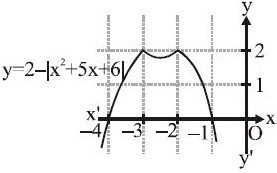
$f(x) = \left\{ \begin{array}{l}
2 - \left| {{x^2} + 5x + 6} \right|,\,\,\,x \ne  - 2\\
{a^2} + 1,\,\,\,\,\,\,\,\,\,\,\,\,\,\,\,\,\,\,\,\,\,\,\,\,x =  - 2
\end{array} \right.$ . Then the range of $a$ , so that $f(x)$ has maximum at $x = -2$, is
  • $\left| a \right| \ge 1$
  • B
    $\left| a \right| < 1$
  • C
    $a > 1$
  • D
    $a < 1$

Answer

Correct option: A.
$\left| a \right| \ge 1$
a
$f(x)$ will have maxima at $x=-2$ only if $a^{2}+1 \geq 2$ or

or $|\mathrm{a}| \geq 1.$

Need a full question paper?

Generate a complete, print-ready paper with questions like this in minutes — across 16+ boards, with answer keys.

Start Generating Free

Similar questions

Choose the most correct of the following statements relating to primal - dual linear programming problems:
A function f from the set of natural numbers to integers defined by $\text{f(n)}=\begin{cases}\frac{\text{n}-1}{2},&\text{when n is odd}\\-\frac{\text{n}}{2},&\text{when n is even}\end{cases}$
If $\int_{0}^{\sqrt{3}} \frac{15 x^{3}}{\sqrt{1+x^{2}+\sqrt{\left(1+x^{2}\right)^{3}}}} d x=\alpha \sqrt{2}+\beta \sqrt{3}$, where $\alpha, \beta$ are integers, then $\alpha+\beta$ is equal to.
The degree of the differential equation$:\frac{\text{d}^2\text{y}}{\text{dx}^2}+3\Big(\frac{\text{dy}}{\text{dx}}\Big)^2=\text{x}^2\log\Big(\frac{\text{d}^2\text{y}}{\text{dx}^2}\Big)$
$\int\text{x}^{\sin\text{x}}\Big(\frac{\sin\text{x}}{\text{x}}+\cos\text{x}\cdot\log\text{x}\Big)\text{dx}$ is equal to:
Let $\phi(\text{x})=\text{f}(\text{x})+\text{f}(2\text{a}-\text{x})$ and f'(x) > 0 for all $\text{x}\in[0,\text{a}].$ Then, $\phi(\text{x}):$
If $y = {\log _2}[{\log _2}(x)]$, then ${{dy} \over {dx}}$ is equal to
Let $A$ be any $3 \times 3$ invertible matrix. Then which one of the following is not always true ?
Let $[.]$ , $ \{.\} $ and $sgn$$(.)$ denotes greatest integer function, fractional part function and signum function respectively, then value of determinant

$\left| {\begin{array}{*{20}{c}}
  {\left[ \pi  \right]}&{amp(1 + i\sqrt 3 )}&1 \\ 
  1&0&2 \\ 
  {\operatorname{sgn} ({{\cot }^{ - 1}}x)}&1&{\{ \pi \} } 
\end{array}} \right|$ is-

Choose the correct answer from the given four options.
The sine of the angle between the straight line $\frac{\text{x}-2}{3}=\frac{\text{y}-2}{3}=\frac{\text{z}-2}{3}$ and the plane $2\text{x}-2\text{y}+\text{z}=5$ is: