MCQ
$f(x) = \left| {\left| x \right| - 1} \right|$ is not differentiable at
  • A
    $0$
  • B
    $ \pm 1,\,0$
  • C
    $1$
  • D
    $ \pm \,1$

Answer

$ = \left\{ \begin{array}{l}|x| - 1,\,\,\,\,\,\,\,|x| - 1 \ge 0\\ - |x| + 1,\,\,\,|x| - 1 < 0\end{array} \right.$
$ = \left\{ \begin{array}{l}|x| - 1,\,\,\,x \le - 1\,\,{\rm{or}}\,x \ge 1\\ - |x| + 1,\,\,\,\,\,\,\, - 1 < x < 1\end{array} \right.$
$ = \left\{ \begin{array}{l} - x - 1,\,\,\,\,\,x \le - 1\\x + 1,\,\,\,\,\,\, - 1 < x < 0\\ - x + 1,\,\,\,\,\,0 \le x < 1\\\,\,x - 1,\,\,\,\,\,\,\,x \ge 1\end{array} \right.$
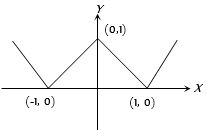
From the graph.
It is clear that $f(x)$ is not differentiable at $x = - 1,\,0$ and $1$.

Need a full question paper?

Generate a complete, print-ready paper with questions like this in minutes — across 16+ boards, with answer keys.

Start Generating Free

Similar questions

If the value of $\frac{3 \cos 36^{\circ}+5 \sin 18^{\circ}}{5 \cos 36^{\circ}-3 \sin 18^{\circ}}$ is $\frac{a \sqrt{5}-b}{c}, $ where $a, b, c$ are natural numbers and $\text{gcd} (a, c) = 1,$ then $a + b + c$ is equal to:
The sum of the series $\frac{1}{2} + \frac{1}{3} + \frac{1}{6} + ........$ to $9$ terms is
The sum of focal distances of any point on the ellipse with major and minor axes as $2a$ and $2b$ respectively, is equal to
The value of $\mathop {Limit}\limits_{x \to \infty } \,\frac{{{{\left( {{2^{{x^n}}}} \right)}^{\frac{1}{{{e^x}}}}}\,\, - \,\,{{\left( {{3^{{x^n}}}} \right)}^{\frac{1}{{{e^x}}}}}}}{{{x^n}}}\,$ (where $n \in N$) is
If $f(x) = \left\{ \begin{array}{l}x\frac{{{e^{(1/x)}} - {e^{( - 1/x)}}}}{{{e^{(1/x)}} + {e^{( - 1/x)}}}},\,x \ne 0\\\,\,\,\,\,\,\,\,\,\,\,\,\,\,\,\,\,\,\,\,\,\,\,\,\,\,\,\,\,0,\,x = 0\end{array} \right.$ then which of the following is true
Let $a ,b ,c $ be such that $b + c \ne 0$  if

$\left| {\begin{array}{*{20}{c}}a&{a + 1}&{a - 1}\\{ - b}&{b + 1}&{b - 1}\\c&{c - 1}&{c + 1}\end{array}} \right| + \left| {\begin{array}{*{20}{c}}{a + 1}&{b + 1}&{c - 1}\\{a - 1}&{b - 1}&{c + 1}\\{{{\left( { - 1} \right)}^{n + 2}} \cdot a}&{{{\left( { - 1} \right)}^{n + 1}} \cdot b}&{{{\left( { - 1} \right)}^n} \cdot c}\end{array}} \right| = 0$ then $n$ equals to

The roots of the equation ${x^2} + ax + b = 0$are $p$, and $q$, then the equation whose roots are ${p^2}q$ and $p{q^2}$ will be
If in triangle $ABC$ ,$ A \equiv (1, 10) $, circumcentre $\equiv$ $\left( { - \,\,{\textstyle{1 \over 3}}\,\,,\,\,{\textstyle{2 \over 3}}} \right)$ and orthocentre $\equiv$ $\left( {{\textstyle{{11} \over 3}}\,\,,\,\,{\textstyle{4 \over 3}}} \right)$ then the co-ordinates of mid-point of side opposite to $A$ is :
Consider system of equations in $x$ , $y$ and $z$

$12x + by + cz = 0$ ;   $ax + 24y + cz = 0$  ;   $ax + by + 36z = 0$ .

(where $a$ , $b$ , $c$ are real numbers, $a \ne 12$ , $b \ne 24$ , $c \ne 36$ ).

If system of equation has solution and $z \ne 0$, then value of  $\frac{1}{{a - 12}} + \frac{2}{{b - 24}} + \frac{3}{{c - 36}}$ is

Let $f(x)=\frac{1}{7-\sin 5 x}$ be a function defined on $R$. Then the range of the function $f(x)$ is equal to: