MCQ
$f(x) = \left| {\left| x \right| - 1} \right|$ is not differentiable at
  • A
    $0$
  • $ \pm 1,\,0$
  • C
    $1$
  • D
    $ \pm \,1$

Answer

Correct option: B.
$ \pm 1,\,0$
b
(b )$ = \left\{ \begin{array}{l}|x| - 1,\,\,\,\,\,\,\,|x| - 1 \ge 0\\ - |x| + 1,\,\,\,|x| - 1 < 0\end{array} \right.$

$ = \left\{ \begin{array}{l}|x| - 1,\,\,\,x \le - 1\,\,{\rm{or}}\,x \ge 1\\ - |x| + 1,\,\,\,\,\,\,\, - 1 < x < 1\end{array} \right.$

$ = \left\{ \begin{array}{l} - x - 1,\,\,\,\,\,x \le - 1\\x + 1,\,\,\,\,\,\, - 1 < x < 0\\ - x + 1,\,\,\,\,\,0 \le x < 1\\\,\,x - 1,\,\,\,\,\,\,\,x \ge 1\end{array} \right.$

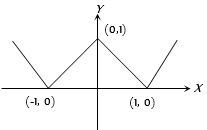
From the graph. It is clear that $f(x)$ is not differentiable at $x = - 1,\,0$ and $1$.
Need a full question paper?

Generate a complete, print-ready paper with questions like this in minutes — across 16+ boards, with answer keys.

Start Generating Free

Similar questions

The projections of a line segment on x, y and z axes are 12, 4 and 3 respectively. The length and direction cosines of the line segment are:

  1. $13;\frac{12}{13},\frac{4}{13},\frac{3}{13}$

  2. $19;\frac{12}{19},\frac{4}{19},\frac{3}{19}$

  3. $11;\frac{12}{11},\frac{14}{11},\frac{3}{11}$

  4. $\text{None of these}$

The function ${{a\sin x + b\cos x} \over {c\sin x + d\,\cos x}}$ is decreasing, if
Let $ABC$ be a triangle such that $\overrightarrow{ BC }=\overrightarrow{ a }, \overrightarrow{ CA }=\overrightarrow{ b }$, $\overrightarrow{ AB }=\overrightarrow{ c },|\overrightarrow{ a }|=6 \sqrt{2}, \quad|\overrightarrow{ b }|=2 \sqrt{3}$ and $\overrightarrow{ b } \cdot \overrightarrow{ c }=12$ Consider the statements.

$( S 1):|(\overrightarrow{ a } \times \overrightarrow{ b })+(\overrightarrow{ c } \times \overrightarrow{ b })|-|\overrightarrow{ c }|=6(2 \sqrt{2}-1)$

$( S 2): \angle ABC =\cos ^{-1}\left(\sqrt{\frac{2}{3}}\right)$. Then

If $a = 2i + 4j + 2k$ and $b = 8i - 3j + \lambda k$ and $a\, \bot \,b,$ then value of $\lambda $ will be
The angle between the straight lines $\frac{{x + 1}}{2} = \frac{{y - 2}}{5} = \frac{{z + 3}}{4}$ and $\frac{{x - 1}}{1} = \frac{{y + 2}}{2} = \frac{{z - 3}}{{ - 3}}$ is ......... $^o$
The area enclosed between the curve $y^2=4 x$ and the line $y=x$ is
Let $\overrightarrow{\mathrm{a}}=\hat{\mathrm{i}}+2 \hat{\mathrm{j}}+\mathrm{k}, \overrightarrow{\mathrm{b}}=3(\hat{\mathrm{i}}-\hat{\mathrm{j}}+\mathrm{k})$. Let $\overrightarrow{\mathrm{c}}$ be the vector such that $\vec{a} \times \vec{c}=\vec{b}$ and $\vec{a} \cdot \vec{c}=3$. Then $\overrightarrow{\mathrm{a}} \cdot((\overrightarrow{\mathrm{c}} \times \overrightarrow{\mathrm{b}})-\overrightarrow{\mathrm{b}}-\overrightarrow{\mathrm{c}})$ is equal to :
The value of $\int_{0}^{\frac{\pi}{2}}\left(\frac{4+3 \sin x}{4+3 \cos x}\right) d x$ is
$\frac{\text{x}}{\text{dx}}\int\text{f(x)}\text{dx}$ is equal to:
  1.  f'(x)
  2. f(x)
  3. f'(x’)
  4. f(x) + c
The area enclosed by the curve $y = \sqrt x \,\, \&\,\, x = - \sqrt y $ , the circle $x^2 + y^2 = 2$ above the $x-$ axis, is