MCQ
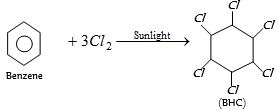
Gammexane is obtained from benzene when it reacts with
  • A
    $B{r_2}$ in bright sunlight (in the absence of a catalyst)
  • $C{l_2}$ in bright sunlight (in the absence of a catalyst)
  • C
    $C{H_3}Cl$ in the presence of anhydrous $AlC{l_3}$
  • D
    $COC{l_2}$ in the presence of anhydrous $AlC{l_3}$
Answer

Correct option: B.
$C{l_2}$ in bright sunlight (in the absence of a catalyst)
b
(b)

Need a full question paper?

Generate a complete, print-ready paper with questions like this in minutes — across 16+ boards, with answer keys.

Start Generating Free

Similar questions

In the following reactions,

$(i) \,\,\begin{array}{*{20}{c}}
  {C{H_3}\,\,\,\,\,\,\,\,\,\,\,} \\ 
  {|\,\,\,\,\,\,\,\,\,\,\,\,\,\,\,\,\,\,} \\ 
  {C{H_3} - C - CH - C{H_3}} \\ 
  {\,\,\,\,\,|} \\ 
  {\,\,\,\,\,\,\,\,\,\,\,\,OH} 
\end{array}\,\xrightarrow{{{H^ + }/heat}}\,\,\mathop A\limits_{[Major\,product]} \, + \,\mathop B\limits_{[Minor\,product]} $

$(ii)\,\, A\xrightarrow[{in\,\,absence\,\,\,of\,peroxide}]{{HBr,\,dark}}\,\,\mathop C\limits_{[Major\,product]} \, + \,\mathop D\limits_{[Minor\,product]} $

the major products $(A)$ and $(C)$ are respectively

What does not change on changing temperature
Which of the following reaction is a redox reaction
The azeotropic mixture of water $(b.p.\,\,, Easy00\,^oC)$ and $HCl\,(b.p.\,\,85\,^oC)$ boils at $, Easy08.5\,^oC$. When this mixture is distilled it is possible to obtain
When electricity is passed through the solution of $AlC{l_3},\,\,13.5\,\,gm$ of $Al$ are deposited. The number of Faraday must be
The number of quantum numbers required to describe an electron in an atom completely is
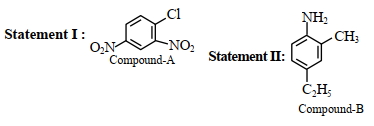
Given below are two statements:

(Image)

$IUPAC$ name of Compound $A$ is $4-$ chloro-$1$, $3$-dinitrobenzene:

(Image)

$IUPAC$ name of Compound $B$ is

$4$-ethyl-$2$-methylaniline.

In the light of the above statements, choose the most appropriate answer from the options given below:

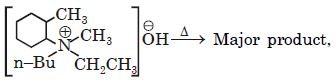
major product is :-
Cyclic hydrocarbon molecule ‘$A$’ has all the carbon and hydrogen in a single plane. All the carbon-carbon bonds are of same length less than $1.54\,\mathop A\limits^o $, but more than $1.34\,\mathop A\limits^o $. The $C - C$ bond angle will be
The number of atoms in $0.1\ mol $ of a triatomic gas is $(N_A = 6.02 \times 10^{23}\, mol^{-1})$