Question
Need a full question paper?
Generate a complete, print-ready paper with questions like this in minutes — across 16+ boards, with answer keys.
Explore more
Similar questions
Calculate the amplification factor of a triode valve that has plate resistance of $2\text{k}\Omega$ and transconductance of 2 millimho.
→A large steel wheel is to be fitted on to a shaft of the same material. At $27{ }^{\circ} C$, the outer diameter of the shaft is 8.70 cm and the diameter of the central hole in the wheel is 8.69 cm . The shaft is cooled using 'dry ice'. At what temperature of the shaft does the wheel slip on the shaft? Assume coefficient of linear expansion of the steel to be constant over the required temperature range :
$
\alpha_{\text {steel }}=1.20 \times 10^{-5} K^{-1}
$
→$
\alpha_{\text {steel }}=1.20 \times 10^{-5} K^{-1}
$
In motor vehicles, a convex mirror is attached near the driver's seat to give him the view of the traffic behind. What is the special function of this convex mirror which a plane mirror can not do?
Read the passage given below and answer the following questions from (i) to (v).
We can say that heat is the form of energy transferred between two (or more) systems or a system and its surroundings by virtue of temperature difference. The SI unit of heat energy transferred is expressed in joule (J) while SI unit of temperature is Kelvin (K), and degree Celsius (°C) is a commonly used unit of temperature. When an object is heated, many changes may take place. Its temperature may rise; it may expand or change state. A measure of temperature is obtained using a thermometer. Many physical properties of materials change sufficiently with temperature. Some such properties are used as the basis for constructing thermometers. The two familiar temperature scales are the Fahrenheit temperature scale and the Celsius temperature scale. The ice and steam point have values 32°F and 212 °F, respectively, on the Fahrenheit scale and 0 °C and 100°C on the Celsius scale. On the Fahrenheit scale, there are 180 equal intervals between two reference points, and on the Celsius scale, there are 100. A relationship for converting between the two scales may be obtained from a graph of Fahrenheit temperature (tF) versus Celsius temperature (tC) in a straight line. When temperature is held constant, the pressure and volume of a quantity of gas are related as PV = constant. This relationship is known as Boyle’s law. When the pressure is held constant, the volume of a quantity of the gas is related to the temperature as V/T = constant. This relationship is known as Charles’ law. Low-density gases obey these laws, which may be combined into a single relationship. PV = μRT where, μ is the number of moles in the sample of gas and R is called universal gas constant: R = 8.31J mol-1 K-1 we have learnt that the pressure and volume are directly proportional to temperature: PVαT. This relationship allows a gas to be used to measure temperature in a constant volume gas thermometer. The absolute minimum temperature for an ideal gas at which pressure becomes zero is found to be – 273.15°C and is designated as absolute zero. Absolute zero is the foundation of the Kelvin temperature scale or absolute scale temperature. The size of unit in Kelvin and Celsius temperature scales is the same. So, temperature on these scales are related by T = tc + 273.15
We can say that heat is the form of energy transferred between two (or more) systems or a system and its surroundings by virtue of temperature difference. The SI unit of heat energy transferred is expressed in joule (J) while SI unit of temperature is Kelvin (K), and degree Celsius (°C) is a commonly used unit of temperature. When an object is heated, many changes may take place. Its temperature may rise; it may expand or change state. A measure of temperature is obtained using a thermometer. Many physical properties of materials change sufficiently with temperature. Some such properties are used as the basis for constructing thermometers. The two familiar temperature scales are the Fahrenheit temperature scale and the Celsius temperature scale. The ice and steam point have values 32°F and 212 °F, respectively, on the Fahrenheit scale and 0 °C and 100°C on the Celsius scale. On the Fahrenheit scale, there are 180 equal intervals between two reference points, and on the Celsius scale, there are 100. A relationship for converting between the two scales may be obtained from a graph of Fahrenheit temperature (tF) versus Celsius temperature (tC) in a straight line. When temperature is held constant, the pressure and volume of a quantity of gas are related as PV = constant. This relationship is known as Boyle’s law. When the pressure is held constant, the volume of a quantity of the gas is related to the temperature as V/T = constant. This relationship is known as Charles’ law. Low-density gases obey these laws, which may be combined into a single relationship. PV = μRT where, μ is the number of moles in the sample of gas and R is called universal gas constant: R = 8.31J mol-1 K-1 we have learnt that the pressure and volume are directly proportional to temperature: PVαT. This relationship allows a gas to be used to measure temperature in a constant volume gas thermometer. The absolute minimum temperature for an ideal gas at which pressure becomes zero is found to be – 273.15°C and is designated as absolute zero. Absolute zero is the foundation of the Kelvin temperature scale or absolute scale temperature. The size of unit in Kelvin and Celsius temperature scales is the same. So, temperature on these scales are related by T = tc + 273.15
- The SI unit of heat energy transferred is expressed in:
- Joule (J)
- Kelvin (K)
- Newton (N)
- None of these
- Temperature is measured using:
- Thermometer
- Barometer
- Tachometer
- None of these
- Relation between Kelvin (T) and Celsius temperature (tc) scale is given by:
- T = tc + 273.15
- T = tc – 273.15
- T = tc
- None of these
- What is heat energy.
- What is absolute zero temperature.
Read the passage given below and answer the following questions from 1 to 5. Simple Harmonic Motion Simple harmonic motion is the simplest form of oscillation. A particular type of periodic motion in which a particle moves to and fro repeatedly about a mean position under the influence of a restoring force is termed as simple harmonic motion (S.H.M). A body is undergoing simple harmonic motion if it has an acceleration which is directed towards a fixed point, and proportional to the displacement of the body from that point. Acceleration $\text{a}\propto-\text{x}$
→$\Rightarrow\text{a}=-\text{kx}$ or $\frac{\text{d}^2\text{x}}{\text{dt}^2}=-\text{kx},$
where x = displacement at any instant t.- Which of the following is not a characteristics of simple harmonic motion?
- The motion is periodic.
- The motion is along a straight line about the mean position.
- The oscillations are responsible for the energy conversion.
- The acceleration of the particle is directed towards the extreme position.
- The equation of motion of a simple harmonic motion is:
-
$\frac{\text{d}^2\text{x}}{\text{dt}^2}=-\omega^2\text{x}$
-
$\frac{\text{d}^2\text{x}}{\text{dt}^2}=-\omega^2\text{t}$
-
$\frac{\text{d}^2\text{x}}{\text{dt}^2}=-\omega\text{x}$
-
$\frac{\text{d}^2\text{x}}{\text{dt}^2}=-\omega\text{t}$
- Which of the following expressions does not represent simple harmonic motion?
-
$\text{x}=\text{A}\cos\omega\text{t}+\text{B}\sin\omega\text{t}$
-
$\text{x}=\text{A}\cos(\omega\text{t}+\alpha)$
-
$\text{x}=\text{B}\sin(\omega\text{t}+\beta)$
-
$\text{x}=\text{A}\sin\omega\text{t}\cos^2\omega\text{t}$
- The time period of simple harmonic motion depends upon:
- Amplitude
- Energy
- Phase constant
- Mass
- Which of the following motions is not simple harmonic?
- Vertical oscillations of a spring
- Motion of a simple pendulum
- Motion of planet around the Sun
- Oscillation of liquid in a U-tube
A saturn year is 29.5 times the earth year. How far is the saturn from the sun if the earth is 1.50 × 10⁸ km away from the sun ?
A steel blade placed gently on the surface of water floats on it. If the same blade is kept well inside the water, it sinks. Explain.
A brass rod of length 50 cm and diameter 3.0 mm is joined to a steel rod of the same length and diameter. What is the change in length of the combined rod at $250{ }^{\circ} C$, if the original lengths are at $40.0{ }^{\circ} C$ ? Is there a 'thermal stress' developed at the junction? The ends of the rod are free to expand (Co-efficient of linear expansion of brass $=2.0 \times 10^{-5} K^{-1}$, steel $=1.2 \times$ $\left.10^{-5} K^{-1}\right)$
→When a fat person tries to touch his toes, keeping the legs straight, he generally falls. Explain with reference to figure.

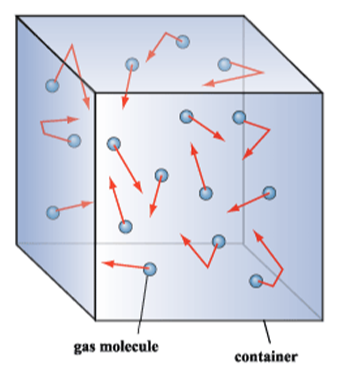
Read the passage given below and answer the following questions from (i) to (v). Pressure of an Ideal Gas: according to kinetic theory of gases pressure is given by
→$\text{P}=\frac{1}{3}\text{ nmv}^2$
Where, n is number of molecules per unit volume, m is mass and v2 is mean squared speed. Though we choose the container to be a cube, the shape of the vessel really is immaterial. The average kinetic energy of a molecule is proportional to the absolute temperature of the gas; it is independent of pressure, volume or the nature of the ideal gas. This is a fundamental result relating temperature, a macroscopic measurable parameter of a gas (a thermodynamic variable as it is called) to a molecular quantity, namely the average kinetic energy of a molecule. The two domains are connected by the Boltzmann constant and given by E = kbT. Where kb is Boltzmann constant having value of 1.38 × 10⁻²³ joule per Kelvin. We have seen that in thermal equilibrium at absolute temperature T, for each translational mode of motion, the average energy is $\frac{1}{2}\text{K}_\text{b}\text{t}$. The most elegant principle of classical statistical mechanics (first proved by Maxwell) states that this is so for each mode of energy: translational, rotational and vibrational. That is, in equilibrium, the total energy is equally distributed in all possible energy modes, with each mode having an average energy equal to $\frac{1}{2}\text{K}_\text{b}\text{t}$. This is known as the law of equipartition of energy. Accordingly, each translational and rotational degree of freedom of a molecule contributes $\frac{1}{2}\text{K}_\text{b}\text{t}$ to the energy, while each vibrational frequency contributes $2\times\frac{1}{2}\text{Kb T}=\text{K}_\text{b}\text{T}$ since a vibrational mode has both kinetic and potential energy modes.- Boltzmann constant has value of:
- 1.38 × 10 - 23 joule per Kelvin.
- 1.38 × 10 - 28 joule per Kelvin.
- 1.38 × 10 - 30 joule per Kelvin.
- None of these.
- SI unit of Boltzmann constant is given by:
- Joules per meter
- Joules per Kelvin
- Joules per Newton
- None of these
- According to kinetic theory give formula for pressure of idea gas.
- According to kinetic theory what is average kinetic energy of molecules of ideal gas?
- What is law of equipartition of energy?