MCQ
Gauss’s law is true for.
  • Any closed surface.
  • B
    For particular surfaces
  • C
    Both $a$ and $b.$
  • D
    None.

Answer

Correct option: A.
Any closed surface.

Need a full question paper?

Generate a complete, print-ready paper with questions like this in minutes — across 16+ boards, with answer keys.
Start Generating Free

Similar questions

When resonance is produced in a series $LCR$ circuit, then which of the following is not correct ?
Permanent magnets are the substances having the property of:
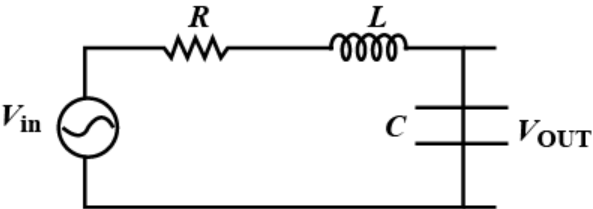
If the output is taken across a capacitor in a series $\text{RLC}$ circuit then it acts as.
Image
Ionisation energy for hydrogen atom in the ground state is $E$. What is the ionisation energy of $Li^{++}$ atom in the $2\ nd$ excited state:
A transformer connected to $220 \,volt$ line shows an output of $2 \,A$ at $11000 \,volt$. The efficiency is $100/%$. The current drawn from the line is......$A$
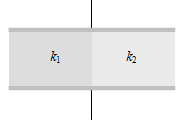
A parallel plate condenser is filled with two dielectrics as shown. Area of each plate is $A \ metre^2$ and the separation is t metre . The dielectric constants are $k_1$ and $k_2$ respectively. Its capacitance in farad will be
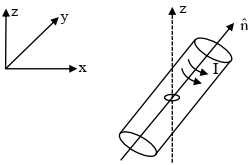
A small circular loop of area $A$ and resistance $R$ is fixed on a horizontal $x y$-plane with the center of the loop always on the axis $\hat{n}$ of a long solenoid. The solenoid has $m$ turns per unit length and carries current $I$ counterclockwise as shown in the figure. The magnetic field due to the solenoid is in $\hat{ n }$ direction. $List-I$ gives time dependences of $\hat{ n }$ in terms of a constant angular frequency $\omega$.

$List-II$ gives the torques experienced by the circular loop at time $t=\frac{\pi}{6 \omega}$, Let $\alpha=\frac{A^2 \mu_0^2 m^2 I^2 \omega}{2 R}$.

$List-I$ $List-II$
($I$) $\frac{1}{\sqrt{2}}(\sin \omega t \hat{j}+\cos \omega t \hat{k})$ ($P$) $0$
($II$) $\frac{1}{\sqrt{2}}(\sin \omega t \hat{j}+\cos \omega t \hat{k})$ ($Q$) $-\frac{\alpha}{4} \hat{i}$
($III$) $\frac{1}{\sqrt{2}}(\sin \omega t \hat{j}+\cos \omega t \hat{k})$ ($R$) $\frac{\alpha}{4} \hat{j}$
($IV$) $\frac{1}{\sqrt{2}}(\sin \omega t \hat{j}+\cos \omega t \hat{k})$ ($S$) $\frac{\alpha}{4} \hat{j}$
  ($T$) $-\frac{3 \alpha}{4} \hat{i}$

Which one of the following options is correct?
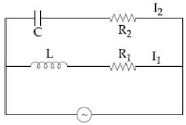
In the below circuit, $C\, = \,\frac{{\sqrt 3 }}{2}\,\mu F,\,R = 20\,\,\Omega ,\,L = \frac{{\sqrt 3 }}{{10}}H$ and ${R_1} = 10\,\,\Omega .$ Current in $L-R_1$ path is $I_1$ and $C-R_2$ path is $I_2.$ The voltage of $A.C$ source is given by, $V\, = \,200\sqrt 2 \,\sin \,(100\,t)\,volts.$ The phase difference between $I_1$ and $I_2$ is
Five lumen/watt is the luminous efficiency of a lamp and its luminous intensity is 35 candela. The power of the lamp is
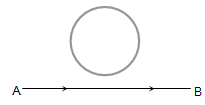
An electron moves along the line AB, which lies in the same plane as a circular loop of conducting wires as shown in the diagram. What will be the direction of current induced if any, in the loop