Question
Get the electric field due to a uniformly charged infinite plane sheet.

Answer

Image
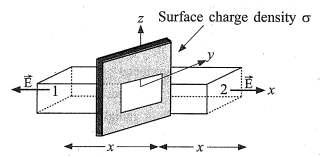
►Let $\sigma$ be the uniform surface charge density of an infinite plane sheet (Fig.). We take the $x$-axis normal to the given plane.
►By symmetry, the electric field will not depend on y and z coordinates and its direction at every point must be parallel to the x-direction.
►We can take the Gaussian surface to be a rectangular parallelpiped of cross-sectional area A, as shown. (A cylindrical surface will also do.)
►As seen from the figure, only the two faces 1 and 2 will contribute to the flux; electric field lines are parallel to the other faces and they, therefore, do not contribute to the total flux.
►Total flux passing through Gaussian surface.
$\begin{aligned}
\phi & =\text { Electric flux passing through Surface } 1 \\
& + \text { Electric flux passing through surface } 2 \\
\therefore \phi & =\text { EAcos } 0+\text { EA } \cos 0 \\
& =\text { EA }+ \text { EA } \\
& =2 EA
\end{aligned}$
►According to Gauss's law $=\phi=\frac{q}{\varepsilon_0}$
Thus, 2EA $=\frac{q}{\varepsilon_0}$
Where, $q=$ electric charge enclosed by
Gaussian surface
$\begin{aligned}
\quad q & =\text { Surface charge density } \times \text { Area } \\
\therefore \quad q & =\sigma A
\end{aligned}$
►Put the value in equation (3),
$\begin{array}{rlrl}
\therefore & 2 EA & =\frac{\sigma A }{\varepsilon_0} \\
\therefore & E & =\frac{\sigma}{2 \varepsilon_0} \\
2 EA & =\frac{\sigma A }{\varepsilon_0} \\
& \text { or, } & E & =\frac{\sigma}{2 \varepsilon_0}
\end{array}$
►Vectorically,
$\overrightarrow{ E }=\frac{\sigma}{2 \varepsilon_0} \hat{n}$
►Where $\hat{n}$ is a unit vector normal to the plane and going away from it, E is directed away from the plate if $\sigma$ is positive and toward the plate if $\sigma$ is negative.

Need a full question paper?

Generate a complete, print-ready paper with questions like this in minutes — across 16+ boards, with answer keys.
Start Generating Free

Similar questions

How are electromagnetic waves produced? What is the source of energy of these waves? Draw a schematic sketch of the electromagnetic waves propagating along the + x-axis. Indicate the directions of the electric and magnetic fields. Write the relation between the velocity of propagation and the magnitudes of electric and magnetic fields.
A hydrogen atom in state n = 6 makes two successive transitions and reaches the ground state. In the first transition a photon of 1.13eV is emitted. (a) Find the energy of the photon emitted in the second transition (b) What is the value of n in the intermediate state?
To increase the current sensitivity of a moving coil galvanometer by 50%, its resistance is increased so that the new resistance becomes twice its initial resistance. By what factor does its voltage sensitivity change?
State difference between the working and non-working current.
The radius of gyration of a uniform disc about a line perpendicular to the disc equals its radius. Find the distance of the line from the centre.
The potential difference across a resistor ‘r’ carrying current ‘I’ is Ir.
  1. Now if the potential difference across ‘r’ is measured using a voltmeter of resistance ‘RV’, show that the reading of voltmeter is less than the true value
  2. Find the percentage error in measuring the potential difference by a voltmeter.
  3. At what value of RV, does the voltmeter measures the true potential difference?
A person standing on the top of a cliff 171ft high has to throw a packet to his friend standing on the ground 228ft horizontally away. If he throws the packet directly aiming at the friend with a speed of 15.0ft/s, how short will the packet fall?
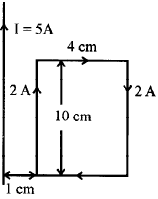
A rectangular loop of wire of size 4cm × 10cm carries a steady current of 2A. A straight long wire carrying 5A current is kept near the loop as shown. If the loop and the wire are coplanar, find
  1. The torque acting on the loop and.
  2. The magnitude and direction of the force on the loop due to the current carrying wire.
In a photoelectric experiment, the collector plate is at 2.0V with respect to the emitter plate made of copper ($\phi$ - 4.5eV). The emitter is illuminated by a source of monochromatic light of wavelength 200 run. Find the minimum and maximum kinetic energy of the photoelectrons reaching the collector.
Give a circuit diagram of a common emitter amplifier using an n-p-n transistor. Draw the input and output waveforms of the signal. Write the expression for its voltage gain.