Question
Get the electric field due to a uniformly charged infinite plane sheet.

Answer

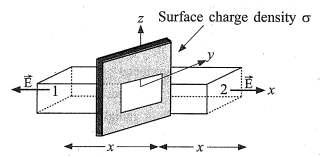
Image
►Let $\sigma$ be the uniform surface charge density of an infinite plane sheet (Fig.). We take the $x$-axis normal to the given plane.
►By symmetry, the electric field will not depend on y and z coordinates and its direction at every point must be parallel to the x-direction.
►We can take the Gaussian surface to be a rectangular parallelpiped of cross-sectional area A, as shown. (A cylindrical surface will also do.)
►As seen from the figure, only the two faces 1 and 2 will contribute to the flux; electric field lines are parallel to the other faces and they, therefore, do not contribute to the total flux.
►Total flux passing through Gaussian surface.
$\begin{aligned}
\phi & =\text { Electric flux passing through Surface } 1 \\
& + \text { Electric flux passing through surface } 2 \\
\therefore \phi & =\text { EAcos } 0+\text { EA } \cos 0 \\
& =\text { EA }+ \text { EA } \\
& =2 EA
\end{aligned}$
►According to Gauss's law $=\phi=\frac{q}{\varepsilon_0}$
Thus, 2EA $=\frac{q}{\varepsilon_0}$
Where, $q=$ electric charge enclosed by
Gaussian surface
$\begin{aligned}
\quad q & =\text { Surface charge density } \times \text { Area } \\
\therefore \quad q & =\sigma A
\end{aligned}$
►Put the value in equation (3),
$\begin{array}{rlrl}
\therefore & 2 EA & =\frac{\sigma A }{\varepsilon_0} \\
\therefore & E & =\frac{\sigma}{2 \varepsilon_0} \\
2 EA & =\frac{\sigma A }{\varepsilon_0} \\
& \text { or, } & E & =\frac{\sigma}{2 \varepsilon_0}
\end{array}$
►Vectorically,
$\overrightarrow{ E }=\frac{\sigma}{2 \varepsilon_0} \hat{n}$
►Where $\hat{n}$ is a unit vector normal to the plane and going away from it, E is directed away from the plate if $\sigma$ is positive and toward the plate if $\sigma$ is negative.

Need a full question paper?

Generate a complete, print-ready paper with questions like this in minutes — across 16+ boards, with answer keys.
Start Generating Free

Similar questions

Find the energy, the frequency and the momentum of an X-ray photon of wavelength 0.10nm.
Distinguish between nuclear fission and fusion. Show how in both these processes energy is released. Calculate the energy release in MeV in the deuterium-tritium fusion reaction:
$^{2}_{1}\text{H} + ^{3}_{1}\text{H}\rightarrow^{4}_{2}\text{H} +\text{n}$
Using the data:
$\text{m}(^{2}_{1}\text{H}) = 2.014102 \text{u}$
$\text{m}(^{3}_{1}\text{H}) = 3.016049\text{u}$
$\text{m}(^{4}_{2}\text{H}) = 4.002603 \text{u}$
$\text{m}_{n} = 1.008665 \text{n}$
$1\text{u} = 931.5\text{MeV/c}^{2}$.
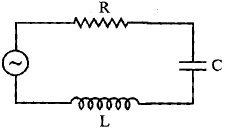
The figure shows a series $\text{LCR}$ circuit with $L = 5.0 H, C = 80 \mu F, R = 40 W$ connected to a variable frequency $240V$ source. Calculate
  1. The angular frequency of the source which drives the circuit at resonance.
  2. The current at the resonating frequency.
  3. The rms potential drop across the capacitor at resonance.
When a photon is emitted by a hydrogen atom, the photon carries a momentum with it.
$(a)$ Calculate the momentum carries by the photon when a hydrogen atom emits light of wavelength $656.3\ nm.$
$(b)$ With what speed does the atom recoil during this transition? Take the mass of the hydrogen atom $= 1.67 \times 10^{-27}kg.$
$(c)$ Find the kinetic energy of recoil of the atom.
In a typical Indian Bugghi $($a luxury cart drawn by horses$),$ a wooden plate is fixed on the rear on which one person can sit. A bugghi of mass $200\ kg$ is moving at a speed of $10\ km/h$. As it overtakes a school boy walking at a speed of $4\ km/h,$ the boy sits on the wooden plate. If the mass of the boy is $25\ kg,$ what will be the new velocity of the bugghi?
Suppose an attractive nuclear force acts between two protons which may be written as $\text{F}=\text{Ce}^{-\text{kr}}/\text{r}^2.$
  1. Write down the dimensional formulae and appropriate $SI$ units of $C$ and $k.$
  2. Suppose that $k = 1 fermi^{-1}$ and that the repulsive electric force between the protons is just balanced by the attractive nuclear force when the separation is $5$ fermi. Find the value of $C.$
Define the electric resistivity of a conductor.
Plot a graph showing the variation of resistivity with temperature in the case of a (a) conductor, (b) semiconductor.
Briefly, explain, how the difference in the behaviour of the two can be explained in terms of number density of charge carriers and relaxation time.
A metre scale made of steel is calibrated at $20^\circ C$ to give correct reading. Find the distance between the $50\ cm$ mark and the $51\ cm$ mark if the scale is used at $10^\circ C.$ Coefficient of linear expansion of steel is $1.1 \times 10^{-5}{ }^{\circ} \mathrm{C}^{-1}.$
Which wavelengths will be emitted by a sample of atomic hydrogen gas (in ground state) if electrons of energy 12.2eV collide with the atoms of the gas?
Consider a non-conducting ring of radius r and mass m that has a total charge q distributed uniformly on it. The ring is rotated about its axis with an angular speed $\omega.$
  1. Find the equivalent electric current in the ring.
  2. Find the magnetic moment $\mu$ of the ring.
  3. Show that $\mu=\frac{\text{q}}{2\text{m}}\text{l}$ where l is the angular momentum of the ring about its axis of rotation.