Electric Charges and Fields — Physics STD 12 Science — Question
Bihar BoardEnglish MediumSTD 12 SciencePhysicsElectric Charges and Fields3 Marks
Question
Get the electric field due to a uniformly charged infinite plane sheet.
✓
Answer
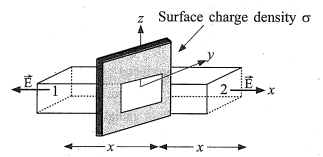
►Let $\sigma$ be the uniform surface charge density of an infinite plane sheet (Fig.). We take the $x$-axis normal to the given plane. ►By symmetry, the electric field will not depend on y and z coordinates and its direction at every point must be parallel to the x-direction. ►We can take the Gaussian surface to be a rectangular parallelpiped of cross-sectional area A, as shown. (A cylindrical surface will also do.) ►As seen from the figure, only the two faces 1 and 2 will contribute to the flux; electric field lines are parallel to the other faces and they, therefore, do not contribute to the total flux. ►Total flux passing through Gaussian surface. $\begin{aligned} \phi & =\text { Electric flux passing through Surface } 1 \\ & + \text { Electric flux passing through surface } 2 \\ \therefore \phi & =\text { EAcos } 0+\text { EA } \cos 0 \\ & =\text { EA }+ \text { EA } \\ & =2 EA \end{aligned}$ ►According to Gauss's law $=\phi=\frac{q}{\varepsilon_0}$ Thus, 2EA $=\frac{q}{\varepsilon_0}$ Where, $q=$ electric charge enclosed by Gaussian surface $\begin{aligned} \quad q & =\text { Surface charge density } \times \text { Area } \\ \therefore \quad q & =\sigma A \end{aligned}$ ►Put the value in equation (3), $\begin{array}{rlrl} \therefore & 2 EA & =\frac{\sigma A }{\varepsilon_0} \\ \therefore & E & =\frac{\sigma}{2 \varepsilon_0} \\ 2 EA & =\frac{\sigma A }{\varepsilon_0} \\ & \text { or, } & E & =\frac{\sigma}{2 \varepsilon_0} \end{array}$ ►Vectorically, $\overrightarrow{ E }=\frac{\sigma}{2 \varepsilon_0} \hat{n}$ ►Where $\hat{n}$ is a unit vector normal to the plane and going away from it, E is directed away from the plate if $\sigma$ is positive and toward the plate if $\sigma$ is negative.
Need a full question paper?
Generate a complete, print-ready paper with questions like this in minutes — across 16+ boards, with answer keys.