Electric Charges and Fields — Physics STD 12 Science — Question
Gujarat BoardEnglish MediumSTD 12 SciencePhysicsElectric Charges and Fields3 Marks
Question
Get the electric field due to on infinitely long straight uniformly changed wire.
✓
Answer
$►$ Consider an infinitely long thin straight wire with uniform linear charge density $\lambda$.
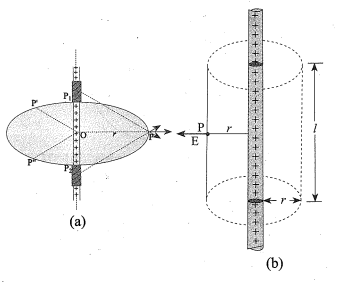
$►$ Suppose we take the radial vector from $O$ to $P$ and rotate it around the wire. The points $P , P ^{\prime}$, $P ^{\prime \prime}$ so obtained are completely equivalent with respect to the charged wire.
$►$ This implies that the electric field must have the same magnitude at these points.
$►$ The direction of electric field at every point must be radial $($outward if $\lambda>0$, inward if $\lambda<0 )$.
$►$ Consider a pair of line elements $P_1$ and $P_2$ of the wire, as shown in Fig. $(a)$
$►$ The electric fields produced by the two elements of the pair when summed, give a resultant electric field which is radial $($the components normal to the radial vector cancel$)$.
$►$ This is true for any such pair and hence the total field at any point $P$ is radial.
$►$ The electric field is everywhere radial in the plane cutting the wire normally, and its magnitude depends only on the radial distance $r$.
$►$ To calculate the field, imagine a cylindrical Gaussian surface, as shown in the Fig. $(b)$.
$►$ Since the field is everywhere radial, flux through the two ends of the cylindrical Gaussian surface is zero.
$\phi=$ Flux through the curved surface of the cylinder
$\therefore \phi=\overrightarrow{ E } \cdot \overrightarrow{ S }$
$\therefore \phi= ES \cos 0 \quad(\overrightarrow{ E } \| \overrightarrow{ S })$
$\therefore \phi= E (2 \pi r l) \text { (S-area of curved surface) } \ldots$
$►$ As per Gauss's law, $\phi=\frac{q}{\varepsilon_0}$
but $q=\lambda l ($electric charge surrounded by Gaussian surface$)$
$\therefore \phi=\frac{\lambda l}{\varepsilon_0}$
$►$ Comparing equation $(1)$ and equation $(2),$
$E (2 \pi r l)=\frac{\lambda l}{\varepsilon_0}$
$E =\frac{1}{2 \pi \varepsilon_0} \cdot \frac{\lambda}{r}$
$►$ Electric field in vector form,
$\overrightarrow{ E }=\frac{1}{2 \pi \varepsilon_0} \cdot \frac{\lambda}{r} \hat{n}$
Where, $\hat{n}$ is unit vector in the direction of electric field.
OR
$\overrightarrow{ E }=\frac{2 k \lambda}{r} \hat{n}\left[\text { where } k=\frac{1}{4 \pi \varepsilon_o}\right]$
Need a full question paper?
Generate a complete, print-ready paper with questions like this in minutes — across 16+ boards, with answer keys.