Question
Give a brief explanation about Radioactivity.

Answer

Becquerel discovered radioactivity in 1896 purely by accident.
While studying the fluorescence and phosphorescence of compounds irradiated with visible light, Becquerel observed a phenomenon.
After illuminating some pieces of uranium - potassium sulphate with visible light, he wrapped them in black paper and separated the package from a photographic plate by a piece of silver. When, after several hours of exposure, the photographic plate was developed.
By doing this, blackness appeared on the photographic plate.
This blackness must be due to some radiation emitted from the compound.
Experiments performed subsequently showed that radio activity was a nuclear phenomenon in which an unstable nucleus undergoes a decay. This is referred to as radioactive decay.
Three types of radioactive decay occur in nature.
(i) $\alpha$-decay in which a helium nucleus ${ }_2 He ^4$ ( $\alpha$-particles) is emitted.
(ii) $\beta$-decay in which electrons or positrons are emitted.
(Positron : particles with the same mass as electron, but with a charge exactly opposite to that of electron.)
(iii) $\gamma$-decay in which high energy (hundreds of $k e V$ or more) photons are emitted.

Need a full question paper?

Generate a complete, print-ready paper with questions like this in minutes — across 16+ boards, with answer keys.
Start Generating Free

Similar questions

If two bodies are in thermal equilibrium in one frame, will they be in thermal equilibrium in all frames?
Three charges $-q, Q$ and $-q$ are situated at equal distances in a straight line. If the total potential energy of the system of all three charges is zero, then what will be the value of ratio $Q : q$ ?
In how many ways the continuous charges are distributed?
Write laws of reflection.
A point source is placed at a depth h below the surface of water (refractive index = μ).
  1. Show that light escapes through a circular area on the water surface with its centre directly above the point source.
  2. Find the angle subtended by a radius of the area on the source.
Write the shortcomings of Rutherford atomic model. Explain how these were overcome by the postulates of Bohr's atomic model.
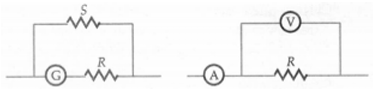
A galvanometer has a resistance of $8 \Omega$ . It gives a full scale deflection for a current of 10 mA. It is to be converted into an ammeter of range 5 A. The only shunt resistance available is of $0.02 \Omega$ , which is not suitable for this conversion. Find the value of resistance R that must be connected in series with the galvanometer (Fig.) to get ammeter of desired range.
Image
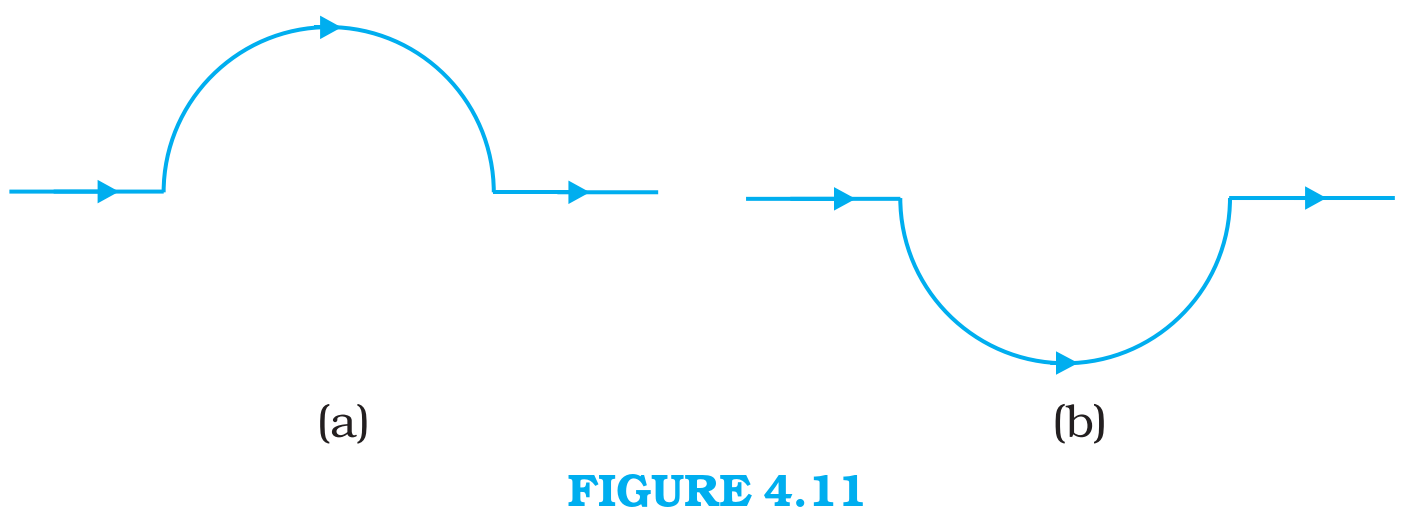
A straight wire carrying a current of $12 A$ is bent into a semi-circular arc of radius $2.0 cm$ as shown in Fig. 4.11 (a). Consider the magnetic field $B$ at the centre of the arc. (a) What is the magnetic field due to the straight segments? (b) In what way the contribution to $B$ from the semicircle differs from that of a circular loop and in what way does it resemble? (c) Would your answer be different if the wire were bent into a semi-circular arc of the same radius but in the opposite way as shown in Fig. 4.11(b)?
Image
A body is weighed by a spring balance to be 1.000kg at the north pole. How much will it weigh at the equator? Account for the earth's rotation only.
A wire of 15 $\Omega$ resistance is gradually stretched to double its original length. It is then cut into two equal parts. These parts are then connected in parallel across a 3.0 volt battery. Find the current drawn from the battery.