Question
Give a definition of Promissory Note and give its four characteristies.

Answer

“A Promissory Note is an instrument in writing (not being a bank note or a currency note) containing an unconditional undertaking signed by the maker to pay a certain sum of money only to or to the order of a certain person or to the bearer of the instrument." -Section 4 of the Negotiable Instruments Act, 1881Features of a Promissory Note:
  1. Promissory Note is an unconditional written undertaking to pay the specified amount.
  2. It is drawn and signed by the maker, i.e., promisor.
  3. It specifies the name of the payee, i.e., to whom payment is to be made.
  4. Specified amount is payable to the specified person or to his order or to the bearer.
  5. Date of payment is specified.

Need a full question paper?

Generate a complete, print-ready paper with questions like this in minutes — across 16+ boards, with answer keys.
Start Generating Free

Similar questions

On the basis of the narrations, fill in the missing values:
Suresh, Kanpur commenced business on 1st January, 2019 introducing capital in cash ₹ 1,00,000. His other transactions during the month were as follows:
2019
 
Jan 1
Started business with cash
1,00,000
Jan 2
Bought goods for cash
20,000
Jan 3
Sold goods for cash
7,000
Jan 15
Sold goods to Shravan, Delhi Bought goods on
6,000
Jan 18
Credit from Anurag, Kanpur
50,000
Jan 19
Goods returned to Anurag
5,000
Jan 20
Sold goods for cash
30,000
Jan 22
Paid electricity bill
1,000
Jan 28
Paid for telephone bill
500
Jan 29
Paid rent
800
Jan 31
Paid wages
3,000
Enter the above transactions in his books of account.
Explain the concept of depreciation. What is the need for charging depreciation and what are the causes of depreciation?
Journalise the following transactions in the books of Shri Manoj, Kolkata and prepare Ledger Accounts. Opening Debit Balances: Cash in Hand ₹ 15,000; Cash at Bank ₹ 55,000; Stock ₹ 28,000; Debtors ₹ 25,000 (Sunil ₹ 5,000; Abhay ₹ 10,000 and Alok ​₹ 10,000); Fixed Assets: Computer and Printer ₹ 50,000; Furniture ₹ 10,000; Delivery Van ₹ 25,000. Opening Credit Balances: Bank Loan ₹ 90,000; Salaries Outstanding ₹ 15,000; Creditors ₹ 20,000; Bills Payable ₹ 10,000; Capital ₹ 73,000. Transactions for the month of April, 2019 were:
  1. Purchased goods from M/s Prabhat Electricals, Delhi ₹ 10,000 less 10% Trade Discount.
Cheque was issued immediately and availed 2% Cash Discount on purchase price.
  1. Cheque was received from Abhay for the balance allowing him discount of 2%*.
  2. Cheque was received from Alok for the balance due*.
  3. Sunil was unable to pay the full dues and offered to pay 75%, which was accepted. Cheque was duly received*.
  4. Gave goods costing ₹ 1,000 as charity. These goods were purchased in Kolkata.
  5. In a competition held by the RWA where the shop is located an electric iron costing ₹ 500 was given as an award. It had been purchased from Prabhat Electricals, Delhi.
  6. A debt of ₹ 10,000 that was written off as bad debt in the past was received*.
  7. Salaries amounting to ₹ 15,000 provided in the books for the month of March, 2019 were paid through cheque*.
  8. Sales for the month were: Cash Sales ₹ 15,00,000 (Intra-state) and Credit Sales ₹ 3,00,000 (Inter-state).
  9. Purchases for the month were: Cash Purchases ₹ 1,00,000 (Intra-state) and Credit
Purchases (Inter-state) ₹ 9,00,000.
Cheques Received from Debtors ₹ 2,00,000; Deposited Cash ₹ 15,00,000.
  1. Paid to creditors through cheques ₹ 8,90,000*.
  2. Bank Loan repaid during the month ₹ 20,000*.
Inter-state transactions are subject to levy of IGST @ 12% and Intra-state transactions are subject to levy of CGST and SGST @ 6% each. GST is not levied on transactions marked with (*).
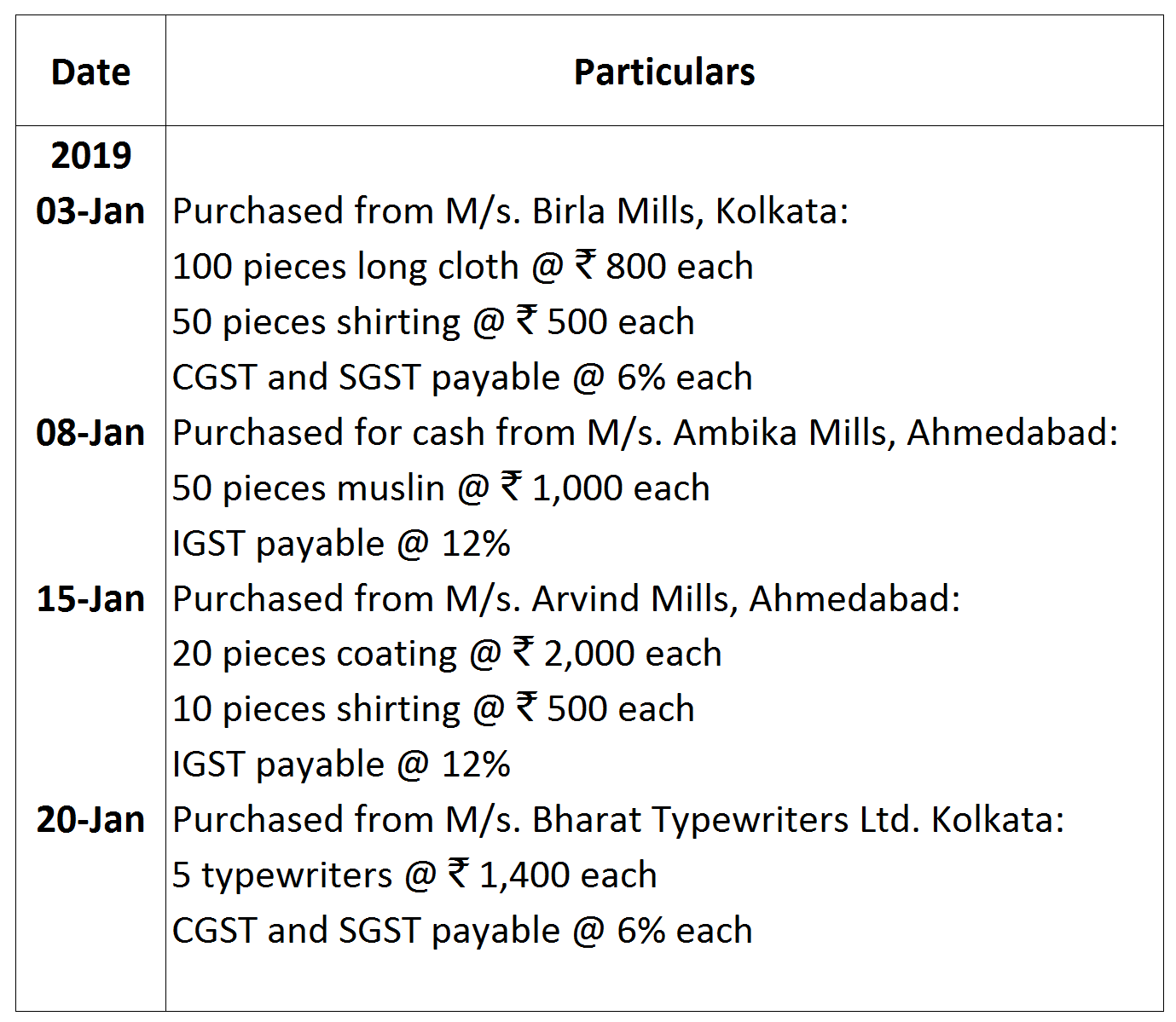
Verma Bros. Kolkata carry on business as wholesale cloth dealer. From the following, write up their Purchases Book for January, 2019:
Show the posting from Purchases Book to Ledger accounts also.
Pass Journal Entries to rectify the following errors:
These errors are located after the preparation of Trial Balance.
i. ₹ 17,000 paid in cash for purchase of a Typewriter was charged to office expenses account.
ii. Credit sale to Abhishek ₹ 5,000 were posted to the Credit of his account.
iii. Cash sales ₹ 20,000 were posted to commission received Account ₹ 200 .
iv. Wages Paid for the construction of office ₹ 9,090 were debited to building Account.
v. Salary payable to Amar ₹ 12,000 was not recorded in the books.
“Is Trial Balance merely a proof of Arithmetical accuracy”? Explain the errors which are not disclosed by a Trial Balance.
On Feb. 14, 2017 Rashmi sold good ₹ 7,500 to Alka. Alka paid ₹ 500 in cash and for the bank balance accepted a bill of exchange drawn upon her by Rashmi payable after two months. On Apr.10, 2017 Alka approached Rashmi to cancel the bill since she was short of funds. She further requested Rashmi to accept ₹ 2,000 in cash and draw a new bill for the balance including interest ₹ 500. Rashmi accepted Alka’s request and drew a new bill for the amount due payable after 2 months. The bill was accepted by Alka. The new bill was duly met by Alka on maturity. Record the necessary journal entries in the books of Rashmi and Alka and prepared Alka’s account in the books of Rashmi’s and Rashmi’s account in the books of Alka’s
Prepare a bank reconciliation statement from the following particulars and show the balance as per cash book.
  1. Balance as per passbook on March 31, 2017 overdrawn ₹ 20,000.
  2. Interest on bank overdraft not entered in the cash book ₹ 2,000.
  3. ₹ 200 insurance premium paid by bank has not been entered in the cash book.
  4. Cheques drawn in the last week of March 2017, but not cleared till date for ₹ 3,000 and ₹ 3,500.
  5. Cheques deposited into bank on February 2017, but yet to be credited on dated March 31, 2017 ₹ 6,000.
  1. Wrongly debited by bank ₹ 500.
Transactions of M/s Vipin Traders are given below.
Show the effects on Assets, Liabilities and Capital with the help of accounting Equation.
a.
Business started with cash
₹ 1,25,000
b.
Purchased goods for cash
₹ 50,000
c.
Purchase furniture from R.K. Furniture
₹ 10,000
d.
Sold goods to Parul Traders (Costing ₹ 7,000 vide bill no. 5674)
₹ 9,000
e.
Paid cartage
₹ 100
f.
Cash Paid to R.K. furniture in full settlement
₹ 9,700
g.
Cash sales (costing ₹ 10,000)
₹ 12,000
h.
Rent received
₹ 4,000
i. Cash withdrew for personal use ₹ 3,000
(Ans: Asset = cash ₹ 78,200 + Goods ₹ 33,000 + Furniture ₹ 10,000 Debtors ₹ 9,000 = ₹ 1,30,200; Liabilities = Capital ₹ 1,30,200)