Question
Give a diagrammatic representation of sub-phylum vertebrata. Write key characters of different classes of Gnathostomata.
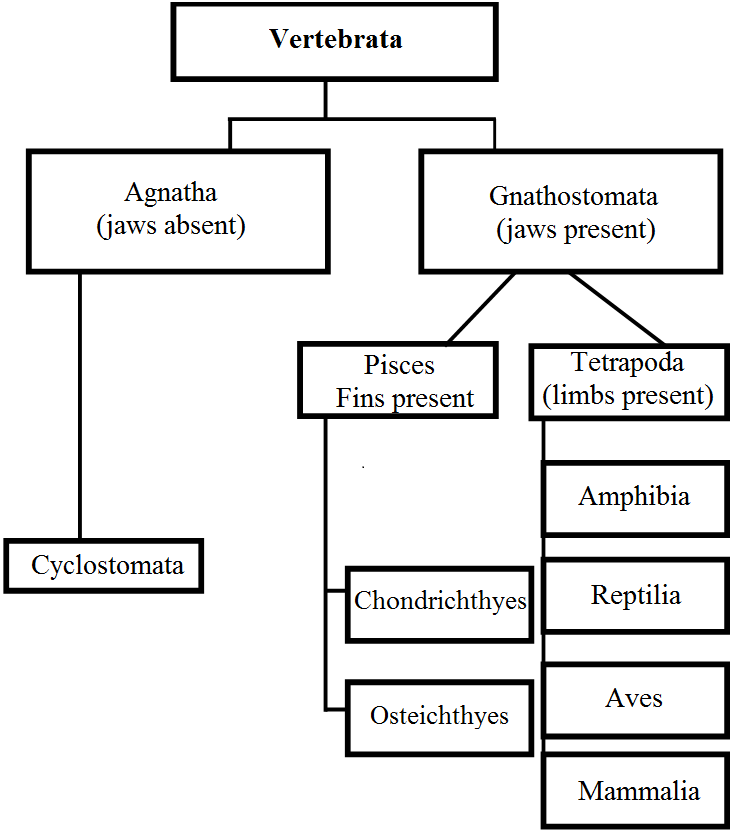
Cranium and vertebral column are cartilaginous. Circulation is of closed type.
Class-Chondrichthyes: They are marine animals with streamlined body and have cartilaginous endoskeleton. Mouth is located ventrally. Notochord is persistent throughout life. Gill slits are separate and without operculum (gill cover). The skin is tough, containing minute placoid scales. Teeth are modified placoid scales which are backwardly directed. Their jaws are very powerful. These animals are predaceous. Due to the absence of air bladder, they have to swim constantly to avoid sinking.
Class-Osteichthyes: It includes both marine and fresh water fishes with bony endoskeleton. Their body is streamlined. Mouth is mostly terminal. They have four pairs of gills which are covered by an operculum on each side. Skin is covered with cycloid/ ctenoid scales. Air bladder is present which regulates buoyancy.
Class-Amphibia:
Unique Characters: The characteristic features of Aves (birds) are the presence of feathers and most of them can fly except flightless birds (e.g., Ostrich). They possess beak. The forelimbs are modified into wings. The hind limbs generally have scales and are modified for walking, swimming or clasping the tree branches. Skin is dry without glands except the oil gland at the base of the tail.
Pneumatic Bones: Endoskeleton is fully ossified (bony) and the long bones are hollow with air cavities (pneumatic). The digestive tract of birds has additional chambers, the crop and gizard.
Generate a complete, print-ready paper with questions like this in minutes — across 16+ boards, with answer keys.