Question
Give a schematic diagram showing basic architecture of a chordate.

Answer

Get the step-by-step solution for this question inside the Vidyadip app.

Get the answer in the app

Need a full question paper?

Generate a complete, print-ready paper with questions like this in minutes — across 16+ boards, with answer keys.
Start Generating Free

Similar questions

Neha while learning for her test, got confused how aerobic pyruvic acid is transported to mitochondria for further oxidation. She asked her elder sister (who is a graduate in biology) about this and also asked her to explain the same process in detail. Her sister explained her that it gets completely oxidised into $\mathrm{CO}_2$ and water along with the formation of ATP.
  1. Mention the sites in the mitochondria, where these events occur.
  2. What happens to pyruvic acid before it enters 'Krebs' cycle?
  3. Write the summary equation for the 'Krebs' cycle.
  4. Mention the value implicit through Neha's character.
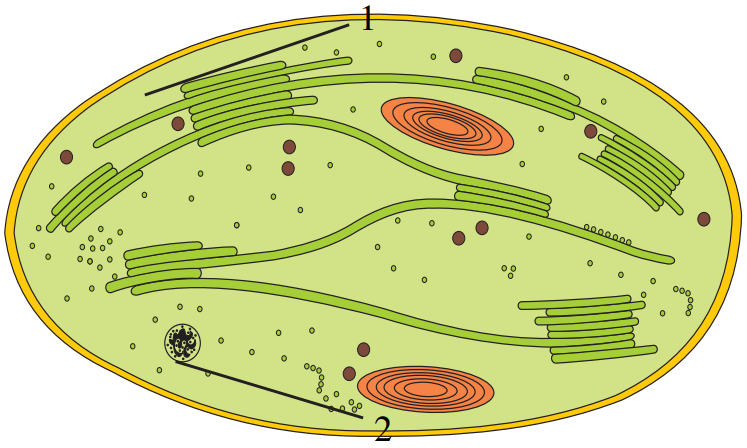
Examine the figure.
  1. Is this structure present in animal cell or plant cell?
  2. Can these be passed on to the progeny? How?
  3. Name the metabolic processes taking place in the places marked (1) and (2).
Explain the mechanism of blood coagulation in response to an injury.
What is erythropoiesis? Write the functions of erythrocytes and thrombocytes.
Give atleast three points of differences between Heartwood and Sapwood.
Each plant or group of plants has some phylogenetic significance in relation to evolution: Cycas, one of the few living members of gymnosperms is called as the ‘relic of past’. Can you establish a phylogenetic relationship of Cycas with any other group of plants that justifies the above statement?
Give a brief account of exchange of gases during respiration.
What conditions enable RuBisCO to function as an oxygenase? Explain the ensuring process.
Biology teacher was teaching cell cycle in the class. She taught that cell is the basis from which life exists. Also explained well about cell cycle. Robin who was a bright student was facing difficulties in understanding the topic he reached home and asked her sister who is a student of biology in a college about details of cell cycle and cell theory. She explained him that according to cell theory, cells arise from pre-existing cells and the process involved is cell division. Sexually reproducing organisms start their life from a single cell, called zygote, and cell divisions do not stop with the formation of a mature organism, but continue throughout the life.
  1. What is meant by cell cycle?
  2. Which is the actual phase of cell division?
  3. When (at what phase) do the cell organelles duplicate?
  4. What values are reflected from the Robin's concern?
Describe the modification of stem in:
  1. Chrysanthemum.
  2. Eichhornia.
  3. Jasmine.