Question
Give an account of structure and function of xylem.

Answer

Xylem is a complex vescular tissue which is composed of several types of cells. Xylem consists of tracheids, vessels, xylem parenchyma and xylem fibres.
The cells of this tissue have thick walls and many of them are non-living.
  1. Tracheids: These are long elongated tubular cells. Tracheids cells are dead. Its main function is conduction of water and minerals from root to stem.
  2. Vessels: These are pipe-like structure. Vessels are dead and have lignified cell wall. They also participate conduction of water and minerals.
  3. Xylem parenchyma: These are living cells which store food material.
  4. Xylem fibres: These are dead cells provide mechanical support to the plant.

Need a full question paper?

Generate a complete, print-ready paper with questions like this in minutes — across 16+ boards, with answer keys.
Start Generating Free

Similar questions

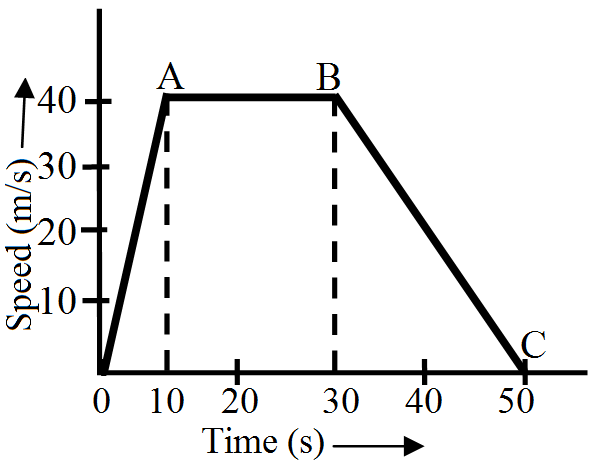
Study the speed-time graph of a car given alongside and answer the following questions:
  1. What type of motion is represented by OA?
  2. What type of motion is represented by AB?
  3. What type of motion is represented by BC?
  4. What is the acceleration of car from O to A?
  5. What is the acceleration of car from A to B?
  6. What is the retardation of car from B to C?
State and prove the law of conservation of linear momentum.
What is artificial insemination? Describe this technique.
If the distance between two masses is increased by a factor of $5,$ by what factor would the mass of one of them have to be altered to maintain the same gravitational force? Would this be an increase or decrease in the mass?
The electronic configuration of an element Z is 2, 8, 8.
  1. What is the atomic number of the element?
  2. State whether element Z is a metal or a non-metal.
  3. What type of ion (if any) will be formed by an atom of element Z? Why?
  4. What is special about the outermost electron shell or the atom of this element?
  5. Give the name and symbol of element Z.
  6. Name the group of elements to which Z belongs.
Calculate the number of aluminium ions present in $0.051g$ of aluminium oxide. $($Hint: The mass of an ion is the same as that of an atom of the same element. Atomic mass of $Al = 27u)$
State Newton’s third law of motion and give two examples to illustrate the law.

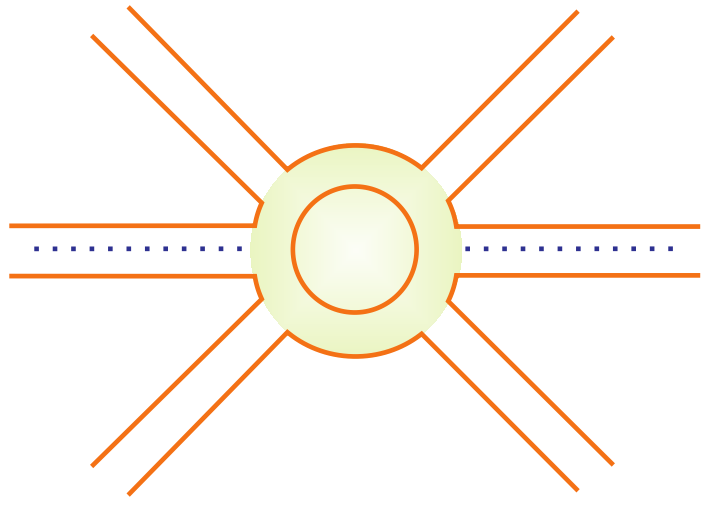
A boy is moving on a straight road against a frictional force of 5N. After travelling a distance of 1.5km he forgot the correct path at a round about (Fig.) of radius 100m. However, he moves on the circular path for one and half cycle and then he moves forward upto 2.0km. Calculate the work done by him.
Draw a neat labelled diagram of an animal cell.
When a beam of sunlight enters a room through a window, we can see tiny particles X suspended in a gas (or rather a mixture of gases) Y which are moving rapidly in a very haphazard manner.
  1. What could particles X be?
  2. Name the gas (or mixture of gases) Y.
  3. What is the phenomenon exhibited by particles X known as?
  4. What is causing the movement of particles X?
  5. What conclusion does the existence of this phenomenon give us about the nature of matter?