Question
Give an account on tracheal system of cockroach.
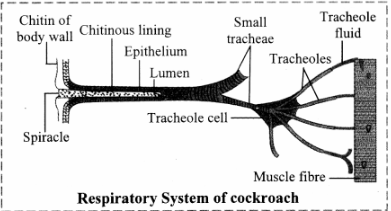
2. Spiracles: They are paired respiratory openings. Spiracles are present on the ventro-lateral side of the body, in pleural membrane. Cockroaches have two pairs of thoracic and eight pairs of abdominal spiracles.The spiracles open into a series of air sacs from which arise the tubes called trachea. The spiracles let the air into and out of trachea.
3. Trachea: The trachea form a definite pattern of branching tubes arranged transversely as well as longitudinally. They are about 1mm thick and have spiral or annular thickening of chitin. The inner lining of chitin prevents the trachea from collapsing. Each trachea further branches into smaller tubes called tracheoles.
4. Tracheoles: These are fine intracellular tubes that penetrate deep into tissues. They are thin and not lined by chitin. They end blindly in the cells. Each tracheole at the blind end is filled with a watery fluid through which exchange of gases takes place. The content of this fluid keeps changing. At high muscular activity, part of fluid part is drawn into the tissues to enable more and rapid oxygen intake.
Generate a complete, print-ready paper with questions like this in minutes — across 16+ boards, with answer keys.