Question
Give an example of micro organisms that have transforming ability.

Answer

A bacterium Agrobacterium tumefaciens has T-DNA in its Ti-plasmid which is able to transform normal plant cells to tumour cell and cause crown gall tumours in plants.
In animals retroviruses have this ability.

Need a full question paper?

Generate a complete, print-ready paper with questions like this in minutes — across 16+ boards, with answer keys.
Start Generating Free

Similar questions

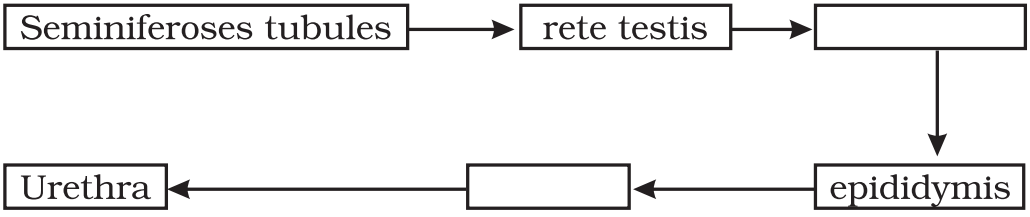
The path of sperm transport is given below. Provide the missing steps in blank boxes.

A dihybrid heterozygous round, yellow seeded garden pea was crossed with a double recessive plant.
  1. What type of cross is this?
  2. Work out the genotype and phenotype of the progeny.
  3. What principle of Mendel is illustrated through the result of this cross?
F1 progeny of pea plant bearing violet flowers and snapdragon plant bearing red flowers were selfed to produce their respective F2 progeny. Compare the phenotypes, the genotypes and the pattern of inheritance of their respective F2 progeny.
Describe how biogas is generated from activated sludge. List the components of biogas.
Double fertilisation is reported in plants of both, castor and groundnut. However, the mature seeds of groundnut are non-albuminous and castor are albuminous. Explain the post-fertilisation events that are responsible for it.
Name any three enzymes used in industry and explain their importance.
A population of Paramoecium caudatum was grown in a culture medium. After 5 days the culture medium became overcrowed with Paramoeium and had depleted nutrients. What will happen to the population and what type of growth curve will the population attain? Draw the growth curve.
Expand IUD.
Briefly classify the extinction processes.
Rearrange the following in the correct sequence to accomplish an important biotechnological reaction:
  1. In vitro synthesis of copies of DNA of interest.
  2. Chemically synthesised oligonucleotides.
  3. Enzyme DNA-polymerase.
  4. Complementary region of DNA.
  5. Genomic DNA template.
  6. Nucleotides provided.
  7. Primers.
  8. Thermostable DNA-polymerase (from Thermus aquatics).
  9. Denaturation of ds-DNA.