Question
Give any three differences between progressive waves and stationary waves. A stationary wave is $\text{y}=12\sin300\text{t}\cos^2\text{x}.$ What is the distance between two nearest nodes?

Answer

S. No.
Progressive Wave
Stationary Wave
1.
All particles have same phase and amplitude.
Amplitude varies with position.
2.
Speed of motion is same.
Speed varies with position.
3.
Energy is transported.
Energy is not transported.
4.
Same change in pressure and density is with every point.
Pressure and density varies with point.

$\text{y}=12\sin300\text{t}\cos2\text{x}$

Comparing with equation of stationary wave

$\text{y}=2\text{A}\sin\omega\text{t}\cos\text{kx}$

$\text{k}=2$

Distance between two consecutive nodes $=\frac{\lambda}{2}$ Where $\lambda$ is wavelength

$\text{k}=\frac{2\pi}{\lambda}$

$\Rightarrow\frac{\pi}{\Big(\frac{\lambda}{2}\Big)}=2$

$\therefore \frac{\lambda}{2}=\frac{\pi}{2}$

So, the distance between two nearest nodes is $\frac{\pi}{2}.$

Need a full question paper?

Generate a complete, print-ready paper with questions like this in minutes — across 16+ boards, with answer keys.
Start Generating Free

Similar questions

For the wave on a string described in Exercise 15.11, do all the points on the string oscillate with the same,
  1. Frequency,
  2. Phase,
  3. Amplitude?
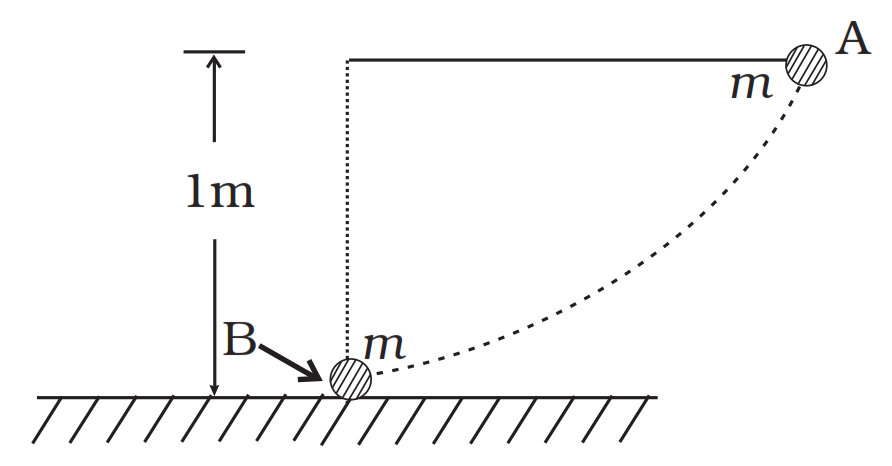
The bob A of a pendulum released from horizontal to the vertical hits another bob B of the same mass at rest on a table as shown in.

If the length of the pendulum is 1m, calculate.

  1. The height to which bob A will rise after collision.
  2. The speed with which bob B starts moving. Neglect the size of the bobs and assume the collision to be elastic.
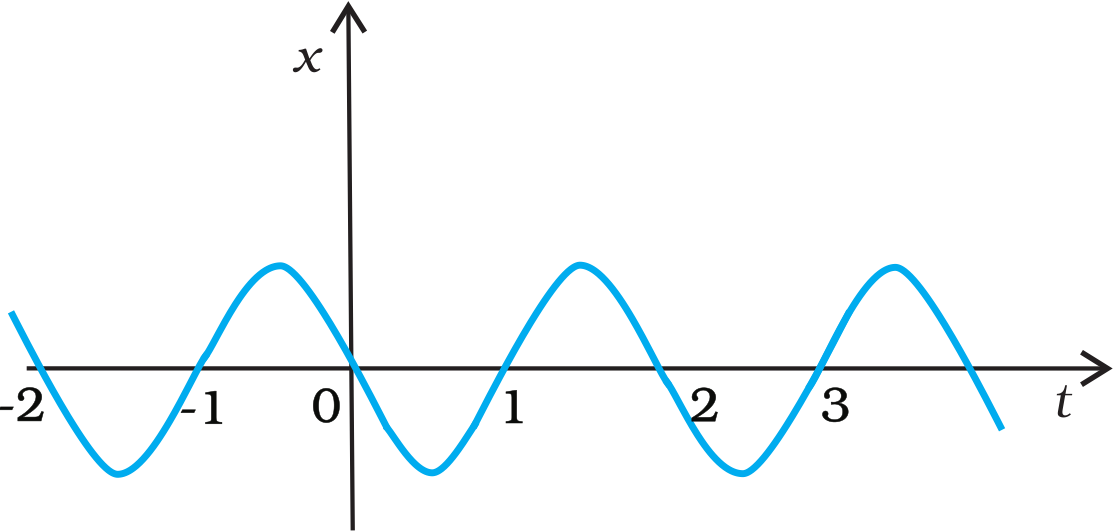
Gives the x-t plot of a particle executing one-dimensional simple harmonic motion. (You will learn about this motion in more detail in Chapter 14). Give the signs of position, velocity and acceleration variables of the particle at t = 0.3 s, 1.2 s, – 1.2 s.

A disc revolves with a speed of $33\frac{1}{3}\text{rev/min},$ and has a radius of 15cm. Two coins are placed at 4cm and 14cm away from the centre of the record. If the co-efficient of friction between the coins and the record is 0.15, which of the coins will revolve with the record?
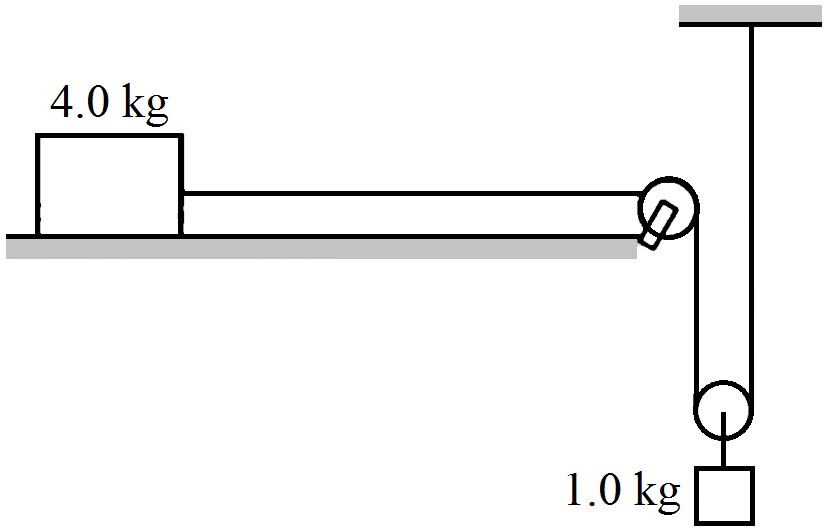
Consider the situation shown in figure. The system is released from rest and the block of mass 1.0kg is found to have a speed 0.3m/s after it has descended through a distance of 1m. Find the coefficient of kinetic friction between the block and the table.

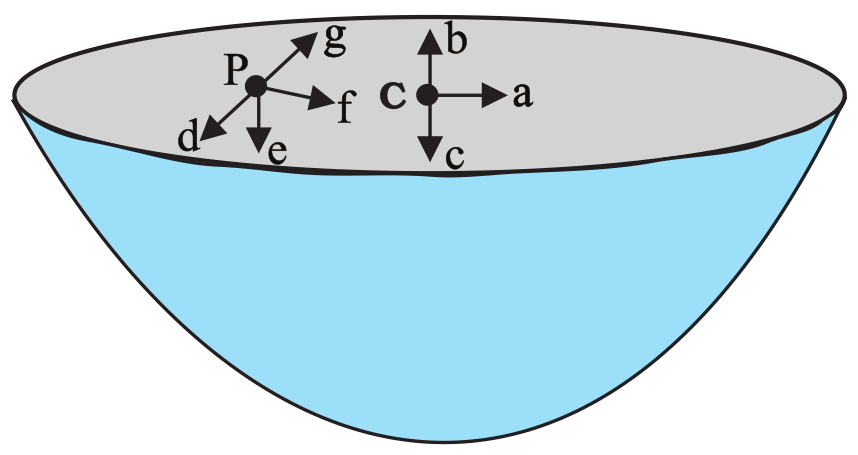
In the following two exercises, choose the correct answer from among the given ones: The gravitational intensity at the centre of a hemispherical shell of uniform mass density has the direction indicated by the arrow (see Fig.) (i) a, (ii) b, (iii) c, (iv) 0.

Compute the bulk modulus of water from the following data: Initial volume = 100.0 litre, Pressure increase = 100.0 atm (1 atm = 1.013 × 10⁵ Pa), Final volume = 100.5 litre. Compare the bulk modulus of water with that of air (at constant temperature). Explain in simple terms why the ratio is so large.
What is meant by limit of elasticity? Write Hooke's law of elasticity. Based on this establish the formula of Young's Modulus of elasticity and give the definition of Young's Modulus of elasticity.
A uniform disc of radius R is put over another uniform disc of radius 2R of the same thickness and density. The peripheries of the two discs touch each other. Locate the centre of mass of the system.
Find the diameter of the image of the moon formed by a spherical concave mirror of focal length 7.6m. The diameter of the moon is 3450km and the distance between the earth and the moon is 3.8 × 10⁵km.